For First Time Since 1968, Isaiah Scroll Is On View At Israel Museum
 The original, handwritten non-facsimile version of the 23-foot-long Isaiah Scroll that survived for 2,000 years in jars hidden in a cave is now on view at the Israel Museum in Jerusalem. The scroll was discovered in 1947 by Bedouin shepherds in Qumran Cave 1, near the Dead Sea. It is made of 17 leather sheets stitched together. “There is something spiritual and moving about seeing this gigantic scroll,” said Professor Noam Mizrahi of Hebrew University. In 1968, the real scroll was replaced with a facsimile for the scroll’s safety. Now, in honor of the museum’s 60th anniversary, the real thing is on view. The scroll is housed in a temperature-controlled room.
Random reads

The Renoir Girls, Catherine Ostler
Three daughters of a prominent French Jewish family, were painted as children by Pierre-Auguste Renoir. One would marry an English aristocrat and escape; one would collaborate with the Nazis; one would die in Auschwitz. This book details the history of the lives behind the portraits.
The Jewish South, Shari Rabin
In 1669, Carolina colony offered freedom of worship to “Jews, heathens, and other dissenters.” Jews settled in cities throughout the Confederate states. These are their stories.
The First Ghetto: Venice and the Origins of Modern Antisemitism, Alexander Lee
In early 16th century, amid mounting religious hatred, the world’s first Jewish ghetto was established in cramped, unsanitary conditions, the prototype for ghettos throughout Europe. The ghetto paved the way for modern antisemitism.
In Weimar, Germany (of all places), Festival Preserves Yiddish Culture
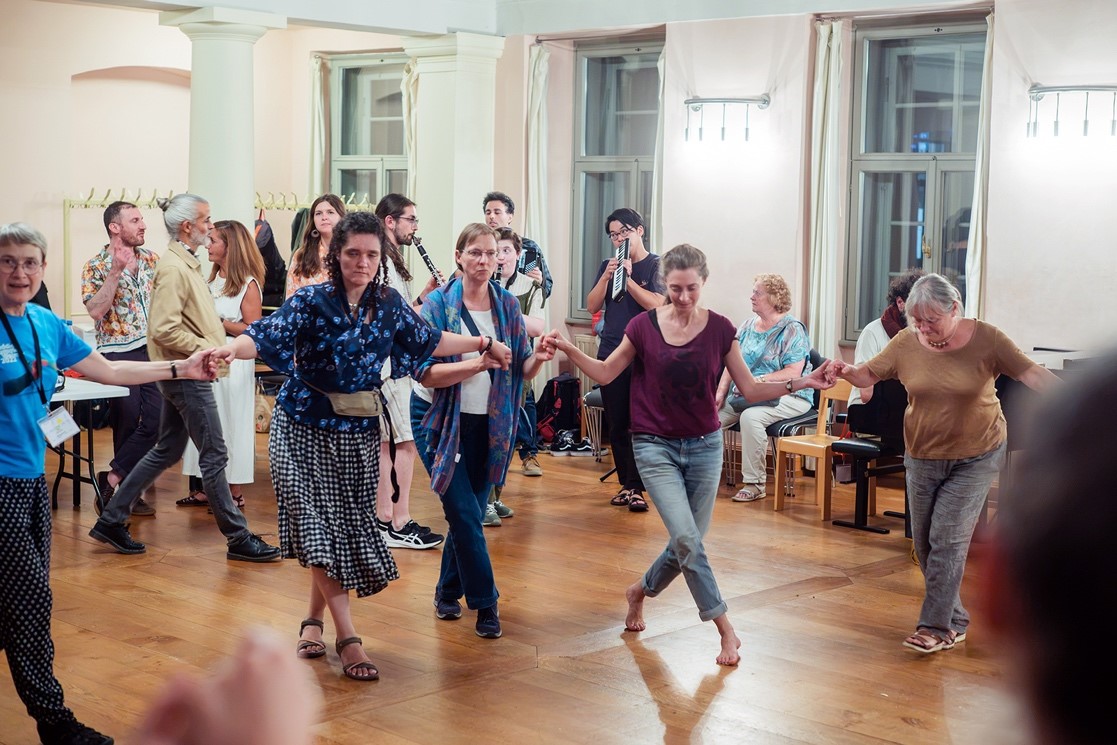 In Weimar, Germany, where the streets once echoed with the notes of Bach, Liszt and Goethe, another European musical tradition has been reverberating for more than a quarter-century: Yiddish. The annual Yiddish Summer Weimar festival brings hundreds of musicians, students and scholars to the former Nazi city for workshops, concerts and performances celebrating the language, music and culture of Ashkenazi Jews that the Nazis sought to destroy.
But since 1998, the program has grown and influenced an interest in Yiddish language and culture from a wide swath of society — Jew and gentile, young and old, religious and secular. What began as a weekend workshop with a handful of participants has become the largest festival of its kind in Europe, lasting more than a month, and attended by more than 10,000 people in total. This summer’s program ran from July 11 through August 15.
Photo by Shendl Copitman
A Journey of Faith and Teshuvah at San Quentin
 Inmates at San Quentin prison celebrate a b’nai mitzvah. The ceremony, held in July 2026, was the culmination of more than a year of study for the nine participants, who ranged in age from late-30s to mid-60s. The multiracial group included men who were raised Christian or without religion, one who identifies as an Israelite, one who has been studying Kabbalah for more than 20 years, and one who wanted to learn Hebrew but became fascinated with Judaism. Rabbi Paul Shleffar, San Quentin’s Jewish chaplain, said the men had deepened their connection to Judaism while doing a form of teshuvah for their crimes.
A Crumby Guide to Tashlich
Tashlich is the symbolic act of casting away one’s sins by throwing bread crumbs into a body of water, usually during the High Holiday season.
Some people have asked what kind of bread crumbs they should throw. Since bread isn’t healthy for the birds that gobble them up, our shul will be using birdseed this year. But that shouldn’t keep us from enjoying the humor of these bread choices:
For ordinary sins: White bread
For exotic sins: French bread
For dark sins: Pumpernickel
For complex sins: Multigrain
For twisted sins: Pretzels
For tasteless sins: Rice cakes
For sins of indecision: Waffles
For sins committed in haste: Matzah
For sins committed in fewer than 18 minutes: Shmurah matzah
For sins of chutzpah: Fresh bread
For committing arson: Toast
For silliness: Nut bread
For not giving full value: Shortbread
For jingoism: Yankee Doodles
For excessive use of irony: Rye bread
For telling bad jokes: Cornbread
For being money-hungry: Enriched bread or raw dough
For warmongering: Kaiser rolls
For immodest dressing: Tarts
For causing injury or damage to others: Tortes
For davening off-key: Flatbread
For being holier-than-thou: Bagels
For unfairly upbraiding another: Challah
For trashing the environment: Dumplings
For sins of laziness: A long loaf
For sins of pride: Puff pastry
For lying: Baked goods made with NutraSweet and Olestra
For wearing tasteless hats: Tam Tams
For the sins of the righteous: Angel food cake
For selling your soul: Devil’s food cake
For lust in your heart: Wonder Bread
For substance abuse: Stoned Wheat
For heavy drugs: Poppy seed bread
For petty larceny: Stollen
For timidity: Milk toast
For risking one’s life unnecessarily: Hero bread
For being hypercritical: Pancakes
For political skulduggery: Bismarcks
For overeating: Stuffing bread or bulky rolls
For gambling: Fortune cookies
For abrasiveness: Grits
For being snappish: Gingerbread
For impetuosity: Quick bread
For incompetent child-rearing: Raisin bread
For negligent slip-ups: Banana bread
For dropping in without warning: Popovers
And this year, for questionable behavior: Wild birdseed
Some Hungarian Holocaust Survivors Pursue Restitution In U.S. Courts
According to an article in the July 13 New York Times, Hungarian Holocaust survivors are trying to sue entities in the country for losses suffered during the Holocaust, citing the following account that had occurred at the time: Iren Gitta Kellner was a teenager when her parents, eight siblings and hundreds of other Jews in their Hungarian town were ordered to the train station with suitcases and crammed into cattle cars by national railway workers who looted their bags on the platform.
She was sent to Auschwitz, among the more than 400,000 Jews in Hungary who were deported to the concentration camp in German-occupied Poland over six weeks in 1944. It was a notoriously brutal period of the Nazi campaign to eliminate European Jewry in World War II. Ultimately about two-thirds of Hungary’s 800,000 Jews were killed.
Ms. Kellner survived, making her way to the United States. She spent her final years fighting, unsuccessfully, for some justice, suing Hungary’s national railway for its participation in the genocide. Now a group of other survivors of the Hungarian Holocaust are hoping that American judges will hear their claims against the national railway in U. S. courts. It is not their first attempt, but it may well be one of their last, and could represent the final hope for relief for a dwindling number of living victims of the atrocities in Hungary.
Whatever happens in the U.S. courts, Ms. Kellner will not get relief. She died late in 2017. “She never lived to see a measure of justice in this case, but her courageous lifetime is a reminder that we must never forget the millions whose intentional slaughter she did survive to recount,” said Richard Weisberg, one of the lawyers representing the survivors.
My Irrational Obsession With An $85 Yarmulke
 Growing up, we had a rule of thumb about yarmulkes: The closer yours was to your forehead, the more strictly religious you were. The frum bochurim placed theirs practically on their noses; the boys from Conservative families bobby-pinned their kippahs on the back of their heads. The cool kids, of course, stuffed theirs in their pockets.
The Jewish skullcap, in other words, was a signifier of much more than the religious precept it embodied. Over the years, not only a yarmulke’s positioning but also its style, size and material have come to place its wearer somewhere on a continuum of Jewish identity. Trends in yarmulke wearing, then, may tell us a story about where Judaism is — forgive me — headed.
So what kind of Jew wears an $85 yarmulke, and what kind of Judaism demands it? These questions gnawed at me when I first learned about Rubenstein Paris, a new kippah couturier whose ads found me on Instagram. Available in a range of expensive-looking solid colors (copper, cream, sapphire) and fabrics (velvet, corduroy, even horsehair), “…these kippahs are here to replace your tattered souvenirs,” the ads said. “Everybody’s just walking around with their kippot from — I don’t know, Mendel and Rachel’s wedding, 2019,” Jonathan Hirsch, Rubenstein’s German-Israeli founder, told me recently. “It’s such a sacred item. Why aren’t there beautiful yarmulkas?
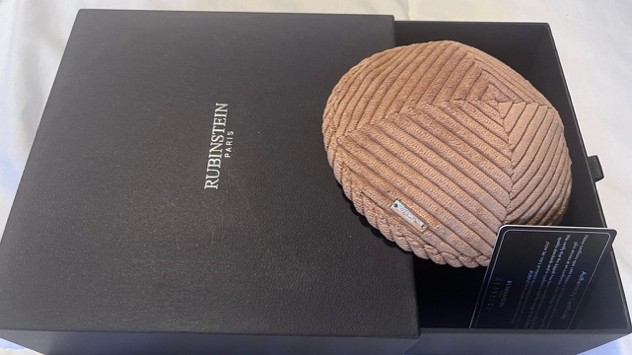
He’s onto something, I thought. Even as an image-conscious, Shabbat-observant millennial, I had largely neglected the yarmulke; when I wanted to look sharp, I ditched it. But when I had to clip up, I made do with whatever I had lying around. Hirsch offered to send a freebie, but at $85, accepting it felt compromising. The loaner we agreed to instead came in a branded drawstring bag, which was accompanied by a sleek black storage box. Although I’d secretly hoped for the horsehair model, the kippah Hirsch sent was more utilitarian: Ribbed velvet, golden brown, with the rise and structural integrity of one of those dome-houses you see in Architectural Digest. Velvet piping twisted around its circumference; its cloth inner lining depicted a globe and a shofar. I put it on.
The story of the kippah begins in the Talmud, when 3rd-century sage Rav Huna proclaimed that he never walked more than four cubits without his head covered to symbolize that the divine presence was always above him. After rabbinic law codified the practice in the 1500s, the kippah evolved into a marker of Jewish cultural mores. For example, 20 years ago, most Modern Orthodox boys wore black suede kippahs, but today, suede is disappearing, replaced by black velvet.
But it’s a fraught moment to be displaying any marker of Jewish identity. Wearing a kippah in public makes you subject to a certain type of attention these days: The glare of being Jewish at a time when antisemitism is on the rise. Hirsch, who is 29 and lives in Berlin, knows this firsthand — these days he doesn’t feel safe wearing a kippah in public. And yet there is a Renaissance in Judaica today driven by new designers and younger consumers finding joy in their heritage. First, ironically, then with some resignation, I found that the Rubenstein was the only kippah I wanted to wear — my fancy kippah became my everyday kippah. Putting it on was a daily treat — I was humored by the upgrade. I began picturing how gloomy and shallow life would be without it. I debated the unthinkable — ponying up to keep the loaner.
I was still conflicted about the idea of this object with sticker-shock. I put the question to Hirsch. There are very few ritual objects, he pointed out, from the kiddush cup to candlesticks to one’s tallit, that we pride ourselves on buying cheap. Why should kippot be the exception?
Hirsch was right, and I expected others to acknowledge my commitment and my sophistication. Only one person complimented me on it — my mother. Everyone else, I’m certain, was stealing covetous glances at my designer yarmulka. But I’m going to return it soon. The premium fabrics, the shofar in the lining, and the devotion it all symbolized were between me and Ha Shem.
By Lewis Keene
Get Social