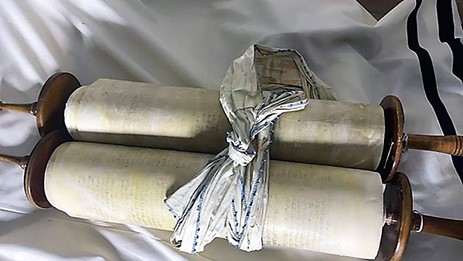
 Rabbi David Maxa first read from a Torah scroll eight years ago during a summer he spent at a camp for Reform Jewish leaders. Maxa, who was visiting from Prague, had traveled to Kutz Camp in the U.S. He didn’t know it then, but the Torah he read from had originated in his home country, in the Czech city of Brno, about 40 years earlier.
On Sept. 28 (Simchat Torah), that same scroll returned to the Czech Republic when Maxa and his nascent Prague congregation, Ec Chajim, welcomed it into their ark.
The return of the Czech scroll to Prague also marks a return of another kind. In the 75 years Following WWII and the near collapse of Jewish life in Europe, many of its treasures, including 1,564 Czech Torah scrolls, made their way to Jewish institutions across the world, the majority in the U.S. and Canada. Now, some of them are returning home, including the Brno Torah scroll, which had been used most recently at Camp Kutz.
Some 117,500 Jews lived in the area of Bohemia and Moravia before the Holocaust. Only about 10,000 survived the war. Jewish life in what is now the Czech Republic was nearly extinguished by the Nazis and the Communists that followed. But Jewish congregational life is finally reemerging.
Thanks to an historical quirk, Czech Jewish liturgical objects, such as Torah scrolls, never disappeared during the Nazi and Communist eras, but were ordered to be packed and shipped to the Jewish Museum in Prague. The Communists tried unsuccessfully to sell them to Israel, but a British lawyer and philanthropist, Ralph Yablon, agreed to buy 1,564 scrolls from the Communists, and turn them over in 1964 to the Westminster Synagogue in London. The synagogue loans out scrolls to Jewish congregations that need them. About 1,000 came to North America. The Kutz camp received one of the Czech scrolls in 1974. The scroll remains the property of the Memorial Scrolls Trust in London, but it will be on permanent loan to the Czech congregation for as long as it needs it.
Get Social