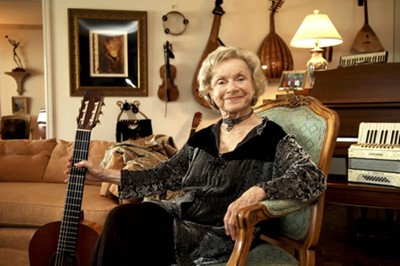
 When Flory Jagoda, the superstar of Ladino music, died in 2021, it was a wakeup call for Vladimir Mickovic, a Bosnian musician from Mostar, who realized that with Jagoda’s death, the music of Sephardic Jews was in danger of being lost forever. “The Sephardic music and culture, their proverbs and literature, is a part of our culture here in Bosnia and Herzegovina,” Mickovic told Religion News Service.
Recently, he released a tribute album to her called “Kantikas de mi Nonna,” or “Songs of my Grandmother,” referring to Flory as the “nonna” of the pre-Holocaust musical tradition of the Balkans.
In the West, Jewish music is often associated with Klezmer, the folk music of Central and Eastern European Jews. But in Spain and across southern Europe, the entirely different music of the Sephardic Jews once thrived. Their language, Ladino or Judeo-Spanish, is a mixture of medieval Spanish, Hebrew and Aramaic, peppered with Turkish, Greek and Serbo-Croatian influences.
Most of Bosnia’s Jews were murdered in the Holocaust. Today, fewer than 1,000 Jews remain. But Mickovic and other Bosnian musicians, none of them Jewish, have pieced together an authentic Bosnian sound, and now are researching the works of other Jewish composers.
Photo: Flory Jagoda in 2002, Tom Pich/Wikipedia/Creative Commons
Get Social