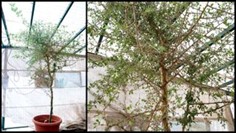
 According to a Dec. 31 article in The New York Times by Franz Lidz, “Camels laden with spices, gold and precious stones accompanied the Queen of Sheba on her biblical journey to Jerusalem in the 10th century B.C. A thousand years later, Flavius Josephus , the Jewish Roman historian, wrote that the haul had included the balm of Gilead a fragrant, highly-prized resin also known as Judean balsam, which served as the basis for perfumes, incense and medicinal remedies.”
The plant vanished from the region by the 9th century, said Sarah Sallon, director of natural medicine research at the Hadassah Hospital in Jerusalem. But in 2010, Dr. Sallon obtained a mysterious seed from the archaeological archives of Hebrew University, hoping that it could germinate. The seed had been discovered in a cave during a 1980s excavation at Wadi el-Makkuk, a winter water channel in the northern Judean desert, and was languishing in storage. After determining that the seed was still viable, Dr. Sallon’s research team planted, sprouted and carefully tended it. When the husk was carbon-dated to between A.D. 993 and A.D. 1202, Dr. Sallon wondered if it could be the source of the balm of Gilead. On the hunch that it was, she named the specimen Sheba.
Since then, the 1,000-year-old seedling has grown into a sturdy 12-foot-tall tree with no modern counterpart. “Not only is it extremely lucky that this one seed survived for a thousand or so years, but that the team managed to successfully germinate the seed and grow the resulting tree to maturity,” Dr. Sallon said, noting that investigation continues, and the possibility that the seed is Judean balsam is intriguing.
Get Social