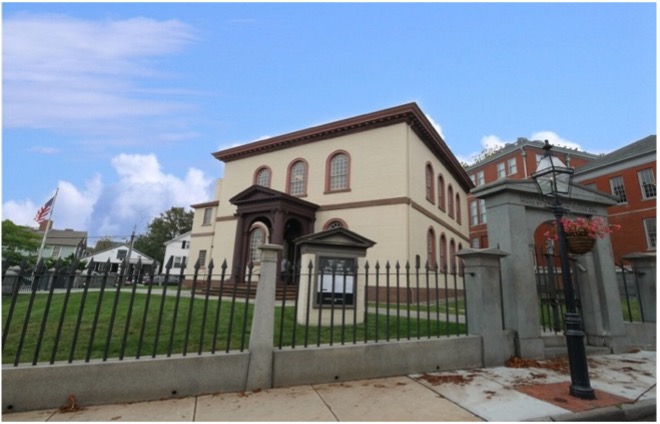
 Jewish Cemetery Preserved by Christians and Jews
Newport, Rhode Island, had once been home to a thriving Colonial Jewish community — also the home of Touro Synagogue, the nation’s oldest surviving Jewish house of worship. But after the Revolutionary War and the city’s economic decline, that community largely faded. Yet the cemetery and the synagogue building remained.
The Jewish burial ground dated to 1677. In 1822, Abraham Touro left money for the upkeep of the cemetery, the synagogue (built in 1763), and the street on which they stood. Newport’s Town Council was authorized to use the interest for repairs.
When Henry Wadsworth Longfellow visited Newport’s Jewish cemetery in 1854, he wrote of the graves as “silent beside the never-silent waves.” He noticed, too, what endured there: “Gone are the living, but the dead remain,” he observed, “and they are not neglected.”
Newport’s preservation of Jewish sacred space was shared. Jews endowed these places and returned to bury their dead there. Christian officials repaired, protected, and publicly honored them. In this way, a Jewish inheritance was carried forward until communal life returned.
In 1883, Touro Synagogue was rededicated, and a new Jewish community was established in Newport. Yet, even in the years when the congregation was gone, the dead were not abandoned.
—Austin Albanese/The Forward
Get Social