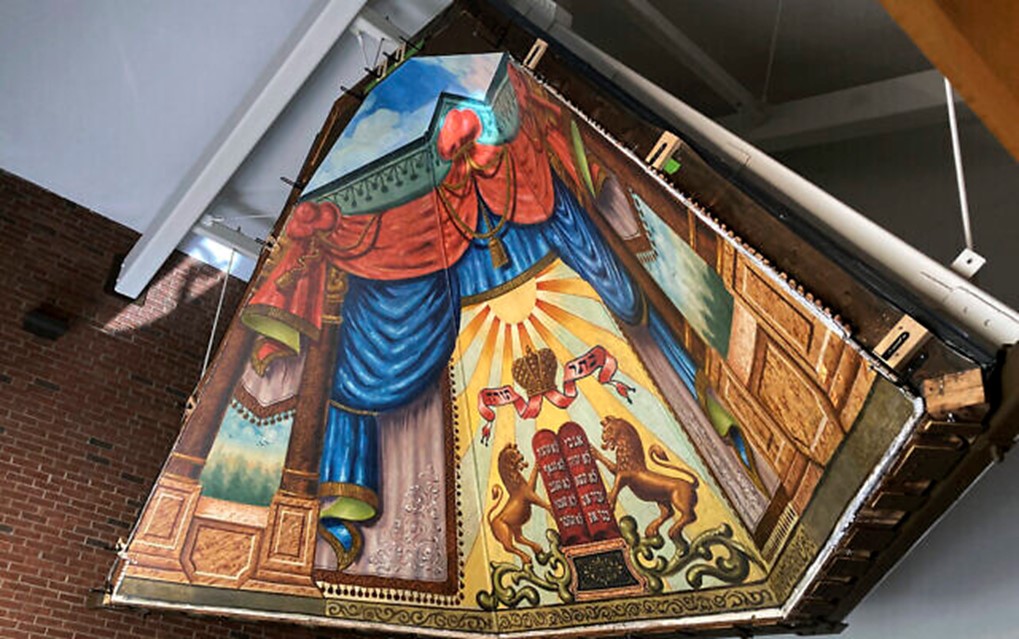
 A mural that was painted in a Vermont Synagogue more than 100 years ago by Ben Zion Black a Lithuanian immigrant — and hidden behind a wall — has been termed a rare piece of art and has been painstakingly moved and restored.
The large, colorful triptych shows the Ten Commandments with a lion on both sides, the sun beating down, and columns and rich curtains at the borders. It has been recognized as a rare representation of a kind that graced wooden synagogues in Europe that were largely destroyed during the Holocaust, said Josh Perelman, chief curator and director of exhibitions and interpretation at the Weitzman National Museum of American Jewish History in Philadelphia.
Black, a sign painter, decorated the inside of the Chai Adam Synagogue in 1910, located in a Jewish neighborhood in Burlington. But the synagogue closed in 1939 when it merged with Ohavi Zedek. The original building went on to have other uses, including a carpet store. When the building was turned into apartments in 1986, Ohavi Zedek archivist Aaron Goldberg and a fellow synagogue member got the owner to install a wall in front of the mural. More than 20 years later, the wallboard was cut away, and photographs were sent to museums around the country, asking what should be done with the artwork. In 2015, the artwork was moved to the current Ohavi Zedek synagogue in Burlington, and the restoration process begun. About $1 million was raised for the project, and the mural was unveiled this summer
Senior Rabbi Amy Small commented on the mural project: “It is significant not only to the Jewish community and the descendants of those early settlers of Burlington, but also to other immigrants in the United States, which offered safety for Jewish and other families fleeing from harm,” she said.
Get Social