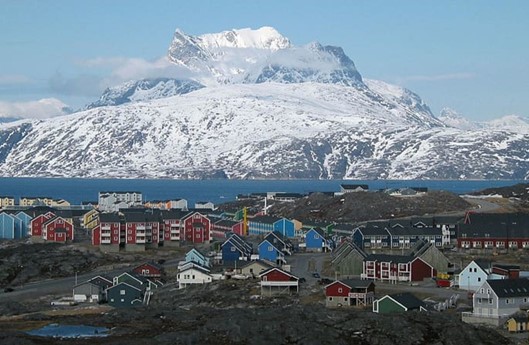
A picturesque village on the southwestern coast of Greenland, where Erik the Red first arrived more than 1,000 years ago, and where sheep outnumber the town’s population 20:1, is the home of Paul Cohen, an American Jew, and his wife Monika, who have lived here for 22 years — and love it. “It’s the Garden of Eden in many ways,” he says — “a little spot of civilization surrounded by pristine wilderness, and I have the unique privilege to be able to live and work here.”
He and Monika first visited Greenland as tourists in 1993 and, in spite of skepticism from family and friends who thought their idea of moving there was just “a phase,” they were serious and moved full-time in 2001.
Fluent in four languages — English, French, German and Danish — Cohen, a professional translator, has decoded hundreds of articles from German to English for the English website of Der Spiegel, also numerous academic books, and more translation work from Danish to English. He also rents properties to travelers.
There has never been an organized Jewish community in Greenland, other than the U.S. military base at Thule in far northwestern Greenland, where in the 1950s, more than 50 Jewish servicemen were stationed, celebrating Passover seders and Shabbat “at the northernmost minyan in the world,” according to the Danish Center for Holocaust Studies. There have been Jewish scientists, journalists, nurses and other professionals working there, a semi-autonomous territory of the kingdom of Denmark, but most were on short-term assignments.
Cohen says that he and Monika plan to live the rest of their lives there, health permitting. “Sometimes the ice recedes a bit and you find yourself walking on land that hasn’t been exposed for thousands of years,” he said. “There are days when I feel not only like I’m the only Jew in Greenland, but maybe the last person on Earth.”
—Dan Fellner/JTA
Excerpted from the Jerusalem Post
[On a personal note, Herbert Michelson, a late uncle of Shofar editor Sara Bloom, was a military officer stationed in Thule for several years during the 1950s. He returned home with stories of the region’s great beauty, friendly people, and how much he enjoyed his assignment there. As a young teenager, I couldn’t imagine living there, but now, having read Paul Cohen’s story…]
Get Social