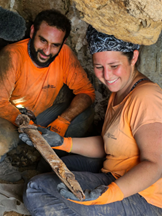
 Fifty years ago, Israeli archaeologists discovered an ancient Hebrew inscription on a stalactite in a remote cave near the Dead Sea. Recently, three researchers — an archaeologist, geologist and photographer — returned to the cave, hoping to find additional inscriptions. While exploring a new level of the cave, they discovered the iron head of a Roman javelin, hidden in a narrow crevice.
The trio immediately contacted the Israel Antiquities Authority, which has been searching Judean desert caves to keep artifacts out of the hands of looters and off the black market.
Meanwhile the three researchers discovered a cache of four 1,900-year-old swords, remarkably well preserved. Even the wood and leather accessories had been preserved in the desert’s arid climate.
The weapons most likely were left in the cave by Jewish rebels involved in the 132 to 136 CE Bar Kokhba Revolt to force the Romans our of the land after nearly two centuries of occupation. The revolt failed but, in the opinion of the IAA, “the swords may represent a small victory seized from the Roman army. The discovery is a major triumph, the best preserved Roman swords, manufactured by Roman armorers, ever discovered anywhere in the world.”
Get Social