In Israel, As Around The World, Remembrances Of The Oct. 7 Attack

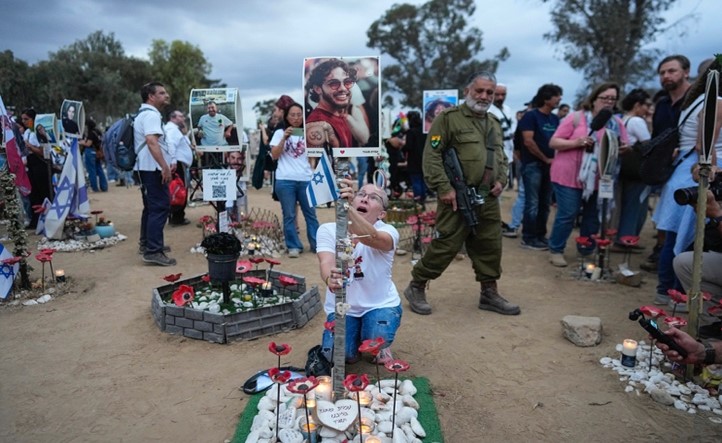

Jerusalem, top photo, people protested outside Prime Minister Benjamin Netanyahu’s house on the one- year anniversary of the Hamas attack on Israel and called for the release of hostages held by Hamas.
Others, left photo, visited the site of the Nova music festival, where hundreds of revelers were killed and many abducted as hostages. In Tel Aviv, people visited a memorial for the victims, right photo.
AP Photos
Shul Offers Membership Windfall for New Families and Individuals
Many people choose to join our shul midway through the year, or even after the High Holidays, which leaves only a few months until dues are due again. Not fair, we said. So here’s the deal: Any individual or family joining between now and the end of the year will pay the new rate — $1,200 for families; $800 for individuals — for the remainder of this year, but will be paid-up members through 2025.
Interested? Know people who are? Email Sara Bloom at citigreenport@gmail.com
Torah scroll presentation
 Rabbi Moshe Lewin, right, shows a Torah scroll to Muslim representative Najat Benali, with pink head covering, and to Father Jason Nioka, a Catholic priest, as other religious leaders look on. The presentation took place in Interreligious Hall at the Olympic Village at the 2024 Summer Olympics in Paris.
AP Photo/Rebecca Blackwell
Weather Update: The WMO Announces Names Of Atlantic Basin Storms
It’s hurricane season 2024, and the venerable World Meteorological Organization has announced the names of this year’s Atlantic Basin storms. Those with generators sitting at the ready can sit back smugly with a “bring-‘em-on” look on their faces. But for the rest, it’s time to lay in a supply of flashlight batteries, candles, lanterns and some extra cans of tuna and jars of peanut butter to feed the family in case of a blackout. Remember, no generator? No stove or microwave. Can’t even heat up some soup.
Some of these storms pass unnoticed, hardly making a ripple in the daily routine here or warranting any media coverage beyond a mere mention buried somewhere and hardly seen except by a few weather junkies. Take tropical storm Alberto, for instance, the first named storm of the season, which made landfall near Tampico, Mexico, on a Thursday morning in late June. Texas and Louisiana took brief notice.
Some have greater impact. Tropical Storm Beryl, the second named storm, a Category 1 hurricane, felt mostly across the south, caused eight deaths and 2.5 million people lost power for days. Here on the North Fork, we had some residual wind and rain as Beryl raced up the coast and out to sea.
Here’s hoping that storms in the making will bypass us this year, and that Chris, Debby, Ernesto, Francine, Gordon, Helene, Isaac, Joyce, Kirk, Leslie, Milton, Nadine, Oscar, Patty, Rafael, Sara, Tony, Valerie and William will pass unnoticed, if they must come at all.
YIVO Institute Will Focus On Diary Of Daily Life Under Nazi Control
A diary recorded by Yitskhok Rudashevski, a teenager in Vilnius during the Nazi Era, offers a different picture of daily life from that of diarist Anne Frank, according to the YIVO Institute for Jewish Research in Manhattan. The institute will focus on this diary in the next installment of its “online museum” of Jewish history.
This diary provides a wider lens on life under Nazi persecution than Anne Frank’s journal because, unlike Anne, he was not isolated and hidden. Yitskhok, at age 13, began chronicling daily life. He recorded the German Army’s takeover of the city from its Soviet occupiers, depicting the confinement of Vilnius’s 55,000 Jews into two ghettos and documenting the first reports of systematic massacres at Ponary, as forested suburb where ultimately 70,000 Jews, 8,000 Soviet war prisoners and 2,000 Polish intelligentsia were shot or machine-gunned to death by Nazi killing squads and Lithuanian volunteers.
According to the diary, in spite of the malnutrition and poor sanitation that inhabitants suffered, they set up schools and youth clubs, published a newspaper, arranged an exhibition on a popular poet, and celebrated the 100,000th book borrowed from the ghetto library.
Yitskhok was murdered at Ponary in October 1943. His cousin located the diary written in Yiddish, in an attic hideaway and gave it to the poet Abraham Sutzkever. Alexandra Zapruder, a co-curator of the online exhibition, said the diary was notable for its “…level of literary ability, command of language, and spirit of observation.”
‘Weddings During The Holocaust,’ An Online Exhibit By Yad Vashem
 An article by Alix Strauss in the July 7 issue of The New York Times’ “Vows” column introduces the focus of a recently added online exhibition, produced by Yad Vashem and titled “Weddings During the Holocaust, which debuted, as planned, on Feb. 14, 2024.
Six months in the making, “Weddings During the Holocaust” is one of 70 ongoing online illustrating exhibits depicting the Holocaust. It is the only retrospective to illustrate couples who married during WWII, at a time when millions of Jews were killed at the hands of the Nazis and their allies, The New York Times said.
The exhibition highlights 11 couples, with 40-plus photos that explore their weddings across various landscapes during three specific times: weddings under restrictive law, depicting the first days of the occupation and deportations while Jews were still in their homes; weddings in ghettos and camps, highlighting Jews who fell in love and wedded in the concentration and labor camps; and weddings after liberation, when Jews were determined to rebuild their lives and their families after the Holocaust.
According to Natalie Mandelbaum, who oversaw the project, “Weddings represented resilience, courage, hope and a desire for life…Together they were much stronger and made each other stronger. These survivors chose life. They chose love. They chose to be together.” Yad Vashem/Kaufmann family
Israeli Teen Discovers Ancient Ring While Hiking On Mount Carmel
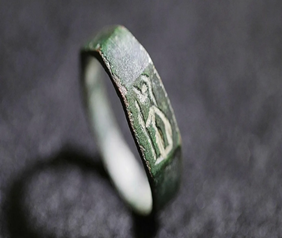 Yair Whiteson, 13, found as bronze ring while hiking with his father. Experts believe it depicts Minerva or Athena and dates be leading to a new chapter,” said Thoufeek Zakriya, a Hebrew calligrapher and scholar of Jewish history.
The settlement on the Carmel forest ridge has been under archaeological investigation for 150 years, yet the ring has only now been found.
Yair and his father gave the ring to the Israel Antiquities Authority, which dated the ring to be about 1,800 years old. It was found at Khirbet Shalala in the midst of the forest on Mount Carmel ridge, which once housed a settlement and farm. It is small, leading the archaeologists to surmise that it belonged to a woman or a child.
The IAA indicated that the ring will be displayed at the Jay and Jeanie Schottenstein National Campus for the Archaeology of Israel in Jerusalem.
Get Social