Language Course Reviving Moroccan Jewish Culture, Bridging Divides
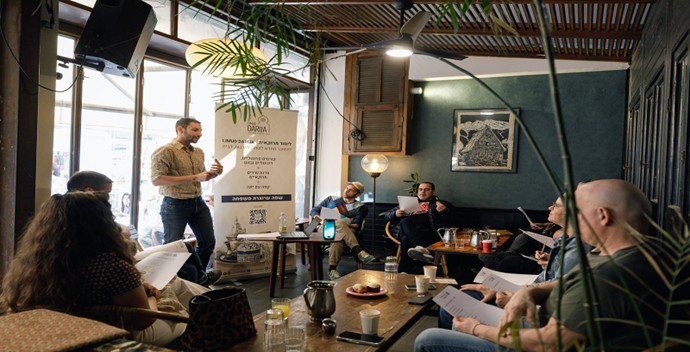
Growing up in Fez, Morocco, Yona Elfassi was always aware of the history of the city, a center of culture and home to great minds, including Maimonides. Only about 2,500 Jews remain in the country; about a million Moroccan Jews make up one of Israel’s largest ethnic groups. Elfassi, a sociologist, now teaches a hybrid course in Darija, the Moroccan Arabic dialect, to allow diaspora Moroccan Jews to connect with their ancestors through language and culture. Classes, social gatherings and celebrations take place in Be’er Sheva, Israel, some Moroccans traveling to Israel for the events. “Bringing people together is peace-building, Elfassi says.
FYI
• Fewer than 200,000 Holocaust survivors — half in Israel — are still alive worldwide, according to data released by the Times of Israel. The number is down from about 220,000 only one year ago. New York is home to the largest population of Holocaust survivors outside of Israel, with an estimated 14,000 to 15,000 living in the metropolitan area.
• Ilana Kantorowicz Shalem, 81, is one of the youngest living survivors of the Holocaust. She was born at Bergen-Belsen, 30 days before the concentration camp was liberated.
• Jon Polin and Rachel Goldberg-Polin, the parents of slain hostage Hersh Goldberg-Polin, would tape the number of days over their hearts until all hostages were home, a practice now ended.
• A new exhibit mounted by the Leo Baeck Institute in New York, titled “And that’s True Too: The Life and Work of Lore Segal,” opened on Jan. 22. Segal, who was raised in England by a foster mother, having arrived on the Kindertransport, died in 2024 at the age of 96. Her work includes an autobiographical novel, Other People’s Houses, decades of stories in The New Yorker, and a children’s book, Tell Me a Mitzi.
Is Beer Kosher? It Used To Be. Times And Ingredients Have Changed
 In November 2025, three of America’s largest kosher-certifying organizations came together to release new guidance regarding the status of beer, which has long been considered kosher by default. But due to the proliferation of flavorings brought on by craft brewing and other industry changes, the rabbis who declare food products to be in line with Jewish dietary laws now say to check the label before drinking.
“We’ve discovered that companies use many flavors to enhance even the simple beers that they manufacture. Those flavors need to be kosherly supervised,” said Rabbi Moshe Elefant, the head of kosher operations at the Orthodox Union, which released the guidance along with Star-K and OK Kosher. “Some beers have dairy in them. They add lactose, they add milk, so a beer could be dairy, which has serious kosher ramifications.”
“Modern factory production involves long supply chains stretching around the world. Before a product hits the shelves, its ingredients may be the work of a dozen factories that result in a final product, and every step of that process needs to be certified to earn the OU stamp,” Rabbi Elefant said. Today. The Orthodox Union employs 55 rabbis in the New York office, and hundreds more in the field.
A Hanukkah Attack, Mass Shooting: Deadly Antisemitism In Australia
Mourners gathered on Dec. 15 at Sydney’s Bondi Beach to light the menorah for the second night of Hanukkah, one day after the mass shooting at a Hanukkah celebration. Officials say a father and son killed 15 people and wounded more than three dozen others at the beachfront gathering, making it one of the deadliest attacks on Jews outside Israel in years. The father, Sajid Akram, 50, was killed, and police said they plan to charge his son, Naveed Akram, 24, as the investigation continues.
 Saeed Khan/AFP via Getty Images
New York To Establish First State-Sponsored Holocaust Memorial
New York Governor Kathy Hochul signed legislation on Dec. 1 that will establish New York’s first state-sponsored Holocaust memorial. The memorial will be built at the Empire State Plaza in Albany, a centerpiece in the state’s capital. New York has a number of Holocaust memorials, but none funded and supported by the state government.
The legislation says the monument will be called the New York State Holocaust Memorial, and will aim to commemorate the victims of the genocide and to “educate the public about the history of the Holocaust and the dangers of antisemitism, racism, and all manifestations of intolerance.” The legislation passed through the state Senate and Assembly unopposed.
Stunning New Book Reveals History And Aesthetics Of The Lost Synagogues Of Europe
Our Synagogue Is Cited In The Acknowledgments
 I met Andrea Strongwater about 20 years ago in a summer writing class at Cornell University. She was wildly energetic about her many pursuits — art, history, writing, painting, and anything having to do with Cornell. I, on the other hand, was quiet writer, elevating my own family’s stories into essays, while a mere visitor to the campus courtesy of my husband, an alum. I admired her many talents. She liked a story I’d written about my father. We became friends.
At the time, she was focused on an idea about somehow recreating the synagogues across Europe that had been destroyed through war, antisemitism and Hitler’s Nazis. To me, it seemed an unattainable goal — how to resurrect what had been destroyed. This practicality did not hinder Andrea’s zeal for the project.
Post Cornell, our email correspondence kept me updated on her myriad adventures and travels — and, of course, the state of the lost synagogues project.
Several weeks ago, I received a large package here at the senior community where I now live. My dinner companions were curious about the contents — the size of the package and the weight of it certain incentives to open it immediately. Under the watchful eyes of my tablemates, I carefully cut through the wrapping and the thick carton, from which emerged a book, Lost Synagogues of Europe, Paintings and Histories Written and Illustrated by Andrea Strongwater.
Teary-eyed with joy for my friend’s accomplishment and success, I opened the large format, 244-page volume, and had hardly leafed through the first page or two, when my fellow spectators wanted a closer look-see. They oohed and aahed at the stunning, full color illustrations, and remarked appreciatively at the intricacy of the research that revealed the splendor of the various synagogues.
Finally wresting the book from my dinnermates, I made my way home for some private time with Andrea’s magnum opus. I read with interest the Judaic context in the foreword by Dr. Ismar Schorsch, chancellor emeritus of the Jewish Theological Seminary, also Andrea’s introduction, which detailed her career and the process that finally resulted in the this historically significant and aesthetically fulfilling work.
As I made my way through the introductory material, I found it remarkable just how many names had contributed to this undertaking, including, to my surprise, the following citation: “…Dr. Carol K. Ingall, the Dr. Bernard Heller Professor Emerita of Jewish Education at The Jewish Theological Seminary, attended my Zoom presentation to Congregation Tifereth Israel in Greenport, New York, and introduced me to Dr. Ismar Schorsch.”
Yes, as Andrea’s project was burgeoning, I invited her to present a “Lunch and Learn” session at our shul. Intrigued by the subject matter, many members and invited guests attended, including shul member Carol Ingall, who provided the introductions to JTS.
Over time, The Shofar has recommended books to its readers through an occasional column titled “Random Reads,” also through selections chosen by the Book Circle group, and from various authors invited to address our membership. With the approach of Hanukkah this month, I call your
attention to Andrea Strongwater’s recreation of an aspect of Jewish culture once destroyed and now resurrected in her stunning presentation — offered at the astonishingly low price of $36.95.
— Sara Bloom
Why Do Jews Eat Chinese Food On Christmas? It’s True, Not A Myth
 Every year around this time, a handwritten sign goes viral on social media, and appears taped to the windows of many of New York’s Chinese restaurants: “The Chinese Rest. Assoc. of the United States would like to extend our thanks to The Jewish People. We do not completely understand your dietary customs… But we are proud and grateful that your GOD insist you eat our food on Christmas.”
Although it’s not prescribed in Jewish texts that we do anything to observe Christmas, American Jews have a long history of breaking out the chopsticks in late December while Christians are slicing into honey-glazed ham.
According to Joshua Eli Plaut, an American Jewish historian, the first documented instance of a “Jewish Christmas” dates to a 1935 New York Times article that mentions restaurant owner named Eng Shee Chuck who brought lo mein to the Jewish Children’s Home in Newark, NJ. Now, Chinese food is an evergreen staple in many Jewish homes. It has been said that moo shoo is among the first non-English words learned by American Jewish children. In 1936, The East Side Chamber News reported the opening of 18 new Chinese tea gardens and chop suey restaurants within a few blocks of Ratner’s, at the time the most popular kosher dairy restaurant in Manhattan.
Part of the early appeal of Chinese restaurants was the lack of Christian iconography unlike that found in Italian establishments. “And the steamed pot sticker looks like kreplach,” Eli Plaut said.
While the time-honored custom of wonton soup during yuletide has its origins in New York, it is now a national habit for American Jewry. As Jews spread throughout the country, Chinese restaurateurs followed some of their best patrons out to the suburbs.
“The Chinese restaurant has become a place for us to announce our identity, and a place where identity expresses itself in a Jewish way on Christmas Eve and Christmas Day,” Plaut said.
[Excerpted from The Forward, by PJ Grisar]
Get Social