From the Rabbi

“The Yarmulke of the World”
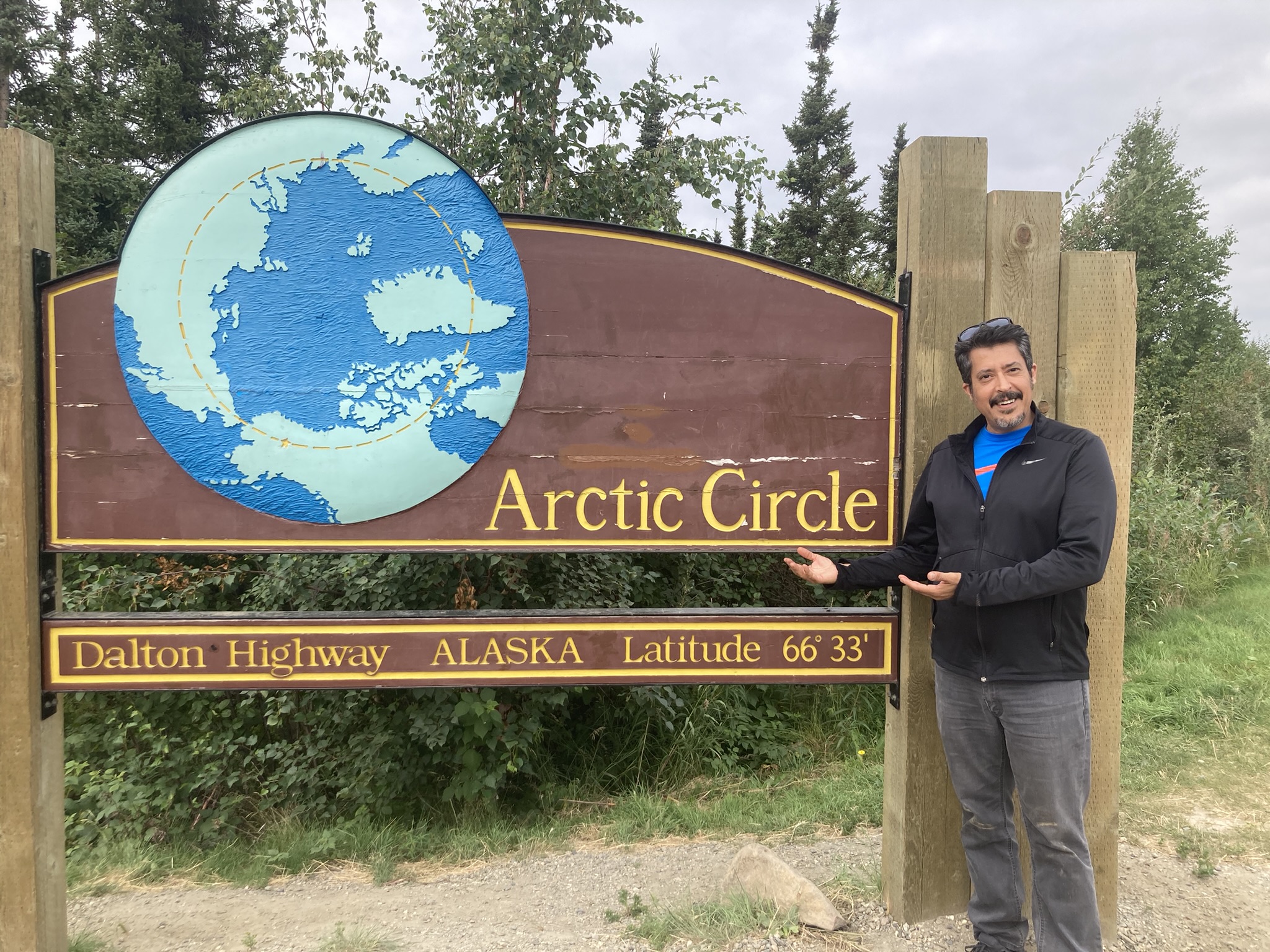 On the third day of my trip to Alaska, I was on my way to the Arctic Circle with a Jewish Alaskan, one of the so-called “Frozen Chosen.” Looking at earth as a human head, the Arctic Circle would be its Yarmulke (kippa). The land within the Arctic Circle includes eight countries: United States, Russia, Canada, Norway, Sweden, Finland, Denmark (Greenland), and Iceland — countries that may disagree yet, like the human head, opposing ideas coexist under that yarmulke. I prayed for world peace.
As we enter our kippah period — Yom Kippur stems from the word kippa, a shield that covers us and protects us — how should we look at the kippah, physically and metaphorically? This discussion has been going on since Biblical times, through Hellenism, and to our days. Should we look at a kippah as a custom that developed in the last few hundred years, an external sign not considered central to our identity? We are commanded in the Bible to wear the fringes of the Tzitzit outwardly. The midrash tells us that God saved us from Egypt because we kept our external signs, such as our names, clothing and language.
Modern Zionism, with its many positive and remarkable achievements, has taught us and the world, as was Herzl’s philosophy, that Jews no longer need any external signs. Fifty years after the Yom Kippur War, we are still debating the place of the Yarmulke in our lives, struggling to put it on. The six-day war was when we took the yarmulke off — thinking and attributing all our victories to our own doing.
It may sound surprising to many people, but the bottom line in Israel’s current judicial reform disagreement is about the Yarmulke. Between religious and secular — secular Kaplan Street in Tel Aviv vs. religious Kaplan Street in Jerusalem. No doubt, many overlapping issues are in play — clashes of the classes, Ashkenazim vs. Sefaradim, yes Bibi vs. no Bibi, basic laws vs. a constitution. We can keep debating until the sun sets over/in/on Alaska… But in the end, it’s about the Yarmulke. Who is our ultimate authority? (You can listen on YouTube to a lecture I gave about the Judicial reform controversy in Israel.)
When Israel’s President, Isaac Herzog, gave his speech in front of a joint session of the U.S. Congress, I was happy and proud. I had a few misgivings but ultimately, it’s always a good thing when an Israeli figure is invited to do so by both sides of the aisle. Herzog spoke about the Jewish legacy of millennia and its inseparable connection to its holy land. He also spoke about his father, who was a previous president of Israel and who spoke in front of Congress 35 years ago. And he mentioned his grandfather, who was the first Chief Rabbi of Israel, and his relationship with President Truman. But at the end, when he was acknowledging the last standing ovation as the non-political representative of the Jewish people, he turned to shake the hands of U.S. Vice President Kamala Harris and Speaker of the House Kevin McCarthy. His head was uncovered, missing something — a yarmulke — an external sign that keeps the link.
A related and amusing occurrence in our own congregation was revealed when Leah Friedman’s actor son, Paul Ben-Victor, was cast in an episode of “Curb Your Enthusiasm” as a High Holidays ticket scalper outside a big synagogue. On the day of the shooting, Leah suggested to Paul that he wear a Yarmulke in the scene. Paul replied that Larry David hadn’t asked him to wear one. But Leah, in her role as a playwright and as a Jewish mother, insisted. After the filming, Larry David approached Paul and said, “Nice touch.”
I wish everyone a Shana Tova U’mtuka, a sweet new year of 5784.
—Rabbi Gadi Capela
“Invocation for Independence”
On July 2, I was asked to deliver an invocation at the Village of Orient’s observance of Heritage Day. In planning my remarks to the villagers and guests, I was reminded that only a few years previous, I had the distinct honor to share that spot with U.S. Supreme Court Justice Sonya Sotomayor. This time it was Southold Town Supervisor Scott Russell, and Suffolk County Legislator Al Krupski. Below is the text of my invocation this year:
We often find ourselves lamenting the lack of unity. A few years ago, I stood in this very spot with Justice Sotomayor, and in an unplanned moment, we both spoke about the Imperfect Union. Perhaps our approach to creating a perfect union is flawed. The clue lies in God’s message that He will speak to us from between the two cherubs atop the Holy Ark. This signifies that He will speak to us through the conversations we have with one another. Our oneness can be realized only through the breath of God, which is our own breath.
It all comes down to conversation. Naturally, we will disagree. As the Talmud states, just as people have different faces, they have different opinions. We will never achieve complete agreement. The only thing we can strive for is healthy discourse.
Maintaining a healthy discourse becomes particularly challenging when it involves matters of land or other tangible desires that both parties share. When it becomes an all-or-nothing situation, conflicts arise – and Cain kills his brother Abel. However, if we make room for diverse voices and options, we create space for God and His voice through us. In fact, one of the names for God is HaMakom, meaning “the space.” By doing so, we prevent destruction, and we are not able to kill.
Interestingly, the Hebrew word for Messiah, “Mashiach,” is a homonym that also means “conversation.” This implies that our redemption will not come from agreeing with each other, but rather from how we conduct our discourse. This is the true heritage.
We must remember that the world did not start with us and (hopefully) will not end with us. When God gave the Torah to Israel on Mount Sinai, He didn’t bestow upon them a private inheritance; He gave them a heritage. The difference is that an inheritance can be kept for oneself, while a heritage is meant to be preserved and passed on. America and the Second Vatican Council have provided a space for the Greenport Ecumenical Ministries, where individuals from various denominations come together as friends.
“Even those I will bring to My holy mountain and make them joyful in My house of prayer. Their burnt offerings and their sacrifices will be acceptable on My alter; For My house will be called a house of prayer for all nations.” (Isaiah 56:7) At the conclusion of Aleinu Leshabeach, the ending of every Jewish prayer, we say: “The Lord will be Ruler over the whole Earth, and on that day, God will be One, and God’s name will be One.”
On this 247th birthday of America, let us celebrate the greatest conversation on Earth.
—Rabbi Gadi Capela
“Transitions”
As her three-year term as the president of our beloved CTI closes, I want to thank Judy Weiner, and express my deepest gratitude and heartfelt appreciation for her outstanding leadership and unwavering dedication throughout the time. Her steadfast commitment to the growth and prosperity of our synagogue have helped propel it into the future, especially during the challenging times of the Covid-19 pandemic. From the moment the pandemic struck, she swiftly pushed to implement necessary measures to ensure the continuity of our spiritual and communal life — adapting our services to virtual platforms, organizing online gatherings and programs, and providing support.
On behalf of the entire congregation, I extend our heartfelt gratitude for her exceptional service and leadership. Judy, as you transition to the next chapter, which will probably involve more free time, please know that your legacy will forever be etched in the fabric of our synagogue’s history. The positive impact of your leadership will be felt for years to come.
Also transitioning are Alan Garmise, who has kept a stable hand on the treasury for a decade, and Madelyn Rothman, who for many years and in varied positions served as a dedicated member of the board. And of course, Sara Bloom, the incoming president, who for many years has obligingly supported our members, visitors, activities and events. To all who serve the shul community, I would like to offer this blessing from our Siddur:
“May God who blessed our ancestors, Abraham, Isaac, and Jacob, Sarah, Rebecca, Rachel, and Leah, bless this holy congregation, together with all others who unite to establish synagogues for prayer, and those who enter them to pray, and those who give funds for heat and light, and wine for Kiddush and Havdalah, bread for the wayfarer and charity for the poor; and all those devotedly involved themselves with the needs of this community and the Land of Israel. May the Holy One reward them, remove sickness from them, heal them, and forgive their sins. May God bless them by making all their worthy endeavors prosper, as well as those of the entire people Israel, and let us say: Amen.”
May we all have a continued blessed journey.
—Rabbi Gadi Capela
Get Social