From the Rabbi

Rabbi Robert L. Wolkoff

Previous Messages
“When the War Started”
I’ll always remember where I was when the war in Ukraine started. I was in HEL (airport lingo for the Helsinki-Vantaa International Airport), exactly a month ago. The night before, I was on a connecting flight to Tel Aviv, diverted back to HEL after an hour in the air. After a long wait, the airline provided us with shuttle transportation to hotels for an overnight stay. Navigating through mountains of snow, and now dragging the extra suitcase I had checked earlier, I felt like a refugee.
The next morning, I was hoping to take advantage of the delay for a little lackadaisical excursion, before my rescheduled flight. But when I turned on the TV, I discovered that while I was sleeping, Russia had invaded Ukraine. As a Jew and an Israeli, I’ve learned from our history that when someone consistently threatens, believe it. As an immigrant son of refugees, the sight of those many thousands of refugees was gut-wrenching and intensely personal.
In one instant, my mindset changed. This was no time for touring. When I arrived back at the airport, it was swarming with people. Finland, which shares a long border with Russia, had to cancel many flights and divert many others from crossing Ukrainian airspace. My flight to Tel Aviv now was re-routed through London.
My stay in Israel reminded me of the Gulf War, when Saddam Hussein invaded Kuwait 31 years ago. I joined the Israeli army that year, right out of high school, and for four years dealt with the threat of chemical weapons. Just like now.
At his conference meeting today, NATO Secretary General Jens Stoltenberg said the use of chemical weapons would be the red line, would force NATO to retaliate with direct military force. Is that where we are now? Should Russia use chemical weapons, as it did in Syria, we are in a world war again? Have we regressed that far? Is Putin stepping back in this dance of history.
It’s always the same war. Someone invades someone else’s space. But, in fact, war really started with Cain and Abel. Cain thought he could overcome the spirit of Abel, powerless to overcome his own inclination. As God said to Cain, be less possessive of others; first possess yourself.
On my way back to New York, I again had a layover of several hours in Helsinki. This time, I was determined to see the sights. It was Purim, so I went to synagogue, hoping to hear a reading of the Megillah — another story of a threatened nation. But the synagogue was closed for security reasons. Instead, I went to the famous Kamppi Chapel of Silence — a quiet sanctuary for self-contemplation. The structure is a modern architectural marvel, a different experience from praying to God at the Kotel, the Western Wall in Jerusalem. Yet, it was similar to the inner experience. A trip that started with a loud bang, was coming to a quiet close. I wanted to hear the delicate voice of God. I sat there for half an hour, until a question came to my mind: How do you really know your mind is silent? The answer came almost instantaneously: when you hear the music. And then my mind was singing.
The message for me was that God is present in the darkest places, too. Sometimes, we need to go to hell, or to HEL as I did, to see what people are truly experiencing. But we don’t have to stay in dark and divisive places. As we prepare for Passover this year, planning to leave Egypt again, let us hope it is for the last time. For me, I’ll always remember where I was when the war started. This year, I’d like to remember that it ends.
—Rabbi Gadi Capela
“The Third Race”
During Black History Month, America remembers the beauty of the African cultures and, at the same time, remembers what was done in the name of race. Just as Jews are sensitive to injustice, so too are Blacks. The racial narrative that often holds superficial external truths, manifested in different skin colors or other physical features, is deeply rooted.
A couple of weeks ago, America was in upheaval over Whoopi Goldberg’s comments regarding the Holocaust: “This is white people doing to white people, so y’all gonna fight amongst yourselves.” Then she added, “It’s about man’s inhumanity to man, however it exposes itself.” There is no argument about the second part. This is man’s inhumanity sinking to the lowest possible level, said Jonathan Greenblatt, national director of the “Anti-Defamation League (ADL), who pointed out that “the Holocaust was about the Nazi’s systematic annihilation of the Jewish people they deemed an inferior race.” In the first chapter of his manifesto, Mein Kampf, Hitler wrote, “People of the same blood should be in the same REICH.”
Whoopi Goldberg apologized for her remarks. “I stand corrected,” she said. I’m not sure she truly understands her mistake, but I must admit, it’s not all her fault. The issue of race and Jews is more complex and is not “Black or White.” It’s about the spark. The spark of light. The light of Torah, living it for a long time, and living in Jewish societies. It’s hard to explain, just as it’s hard to explain the reaction of anti-Jews or antisemitism. The biggest anti-Semites, from Pharaoh to Haman and Hitler, looked at the Jewish people and determined that they are spread throughout different countries, and yet they are one people. One family.
Let me offer a Jewish perspective on this. Antisemitism comes from the name Semite — as in Shem, the first son of Noah. According to Genesis 10, the known 70 nations are the descendants of the three sons of Noah: the Hamitic, the Semitic, and the Japhetic. The midrash claims that they spread to three continents: Africa, Europe and Asia. The sons of Ham (which means hot) are Kush and Mitzrayim — Nigeria and Egypt, both in Africa. The son of Japheth (which means beauty) is Yavan — Greece, the cradle of European culture, beauty and architecture. The son of Shem (which means name) is Ever — Hebrews with their origin in Asia. The Jews are an ethnicity within the Semitic race, and will carry the name of the one God.
On my trip and the preparations for it, I needed several times to designate my racial identity. I would like to select “Jew,” not Black or White. Being Jewish for me was never about color. I grew up in Israel with first- or second-generation kids from 25 countries in my homeroom alone. All colors and shades. A family of common descent. To say that Jews are not of an ethnic background is to ignore a significant part of the Jewish identity. Most of the Jews in the world would not deny they come from an original ethic background that belongs to a race — the Semite race. The third race in the middle that is often ignored.
When we fill in our information on any application, we are asked to indicate our race. Usually, the options are Black/African, White, Native Hawaiian, Alaska Native, Asian, American Indian, American, and even Other Pacific Islander. Where is the Semite? So, it’s not all Whoopi Goldberg’s fault. When race becomes Black or White, then Jews have to be assigned a side. It was convenient for Jews coming to America from Europe to fall into that rubric, even though they were not white enough in Europe, and it took them a while to become white enough in America. But the Semites are not about the color of their skin. The mission of its people is to carry God’s name wherever they are.
In the end, we are all descendants of Homo sapien that overcame the Neanderthal. In Hebrew, the word race is geza, which refers to a tree trunk. Adam, as a reference to humanity, is one. So really, there is only one race, one tree trunk from which all branches stem. Let us be one and believe in One.
— Rabbi Gadi Capela
“Captives Of Hope Are Not Helpless”
Two days after the hostage situation at Congregation Beth Israel in Colleyville, Texas, the congregation conducted a healing service at a nearby church. The place was full. I watched it live. One of the compelling themes offered by Rabbi Charlie Cytron-Walker, spiritual leader of the congregation, was this: “We are not helpless! No one would be saying the Mourner’s Kaddish, thank God, thank God.” There will always be tests, he said, but the answer is always the same: “Like every journey, we will take the next step. We stand together against hatred.”
Three days later, The Wall Street Journal ran a story about Colleyville, reporting that an elite FBI team had flown in from Quantico, stormed the synagogue, and released the hostages. At that point, it was already widely known that it was Rabbi Cytron-Walker’s heroic act that had broken the grueling, 11-hour standoff, and that he and his two congregants had not been rescued, but had escaped on their own. They were not helpless.
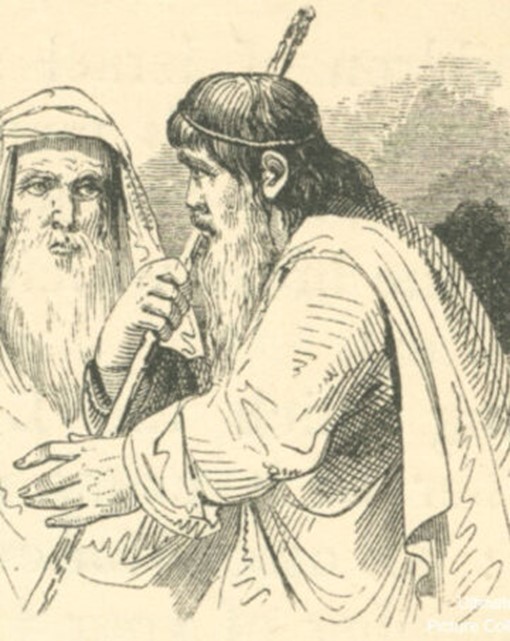
The following Shabbat, we read in Parashat Yitro that Jethro hears and then comes from afar to join Moses and the Israelites. He heard what God had done for the Jewish people and he came. Rashi asks, “What did he hear?” He heard that we were not helpless, that God helped us, but that we can also help ourselves by creating a system to prepare ourselves. [Wikipedia image, Jethro comes to Moses in the wilderness.]
 Rabbi Angela Buchdahl of Central Synagogue in Manhattan was a key figure in the gunman’s demands. He insisted that the Colleyville synagogue contact her in order to free a Pakistani terrorist. Rabbi Buchdahl gave a stirring sermon the following Shabbat, citing the theme of perseverance. “The Jewish people,” she said, “have been trained to be ‘captives of hope.’”
In an essay in The Times of Israel, Rabbi Jay Rosenbaum wrote that the Jewish people have been caught between two extreme narratives: total helplessness and invincibility. “Having been vulnerable and politically weak for 2,000 years, it is natural to fear any sign of weakness,” he wrote. “It’s natural to think that any sign of vulnerability means we’re back in Egypt, a state of deep helplessness…The world has bought into this mythology, too… Either we the Jewish people are Superman — invincible and invulnerable — or we are Holocaust victims…Perhaps we need to change the narrative…We can be strong without being invincible…We need to remind the world of that…No one should have to be a total victim to qualify for sympathy.”
CBI could have been CTI or the name of any other synagogue. Just as the people of Israel learned to defend themselves back in their land, the people of every synagogue need to learn to defend themselves in their own synagogues, their Jewish land. While we can hear what happened in Colleyville, we need to listen as well and to act. Sometimes we need only to throw a chair to save ourselves. Captives of hope are never helpless.
May we have a safe and blessed month,
—Rabbi Gadi Capela
Get Social