 Growing up, we had a rule of thumb about yarmulkes: The closer yours was to your forehead, the more strictly religious you were. The frum bochurim placed theirs practically on their noses; the boys from Conservative families bobby-pinned their kippahs on the back of their heads. The cool kids, of course, stuffed theirs in their pockets.
The Jewish skullcap, in other words, was a signifier of much more than the religious precept it embodied. Over the years, not only a yarmulke’s positioning but also its style, size and material have come to place its wearer somewhere on a continuum of Jewish identity. Trends in yarmulke wearing, then, may tell us a story about where Judaism is — forgive me — headed.
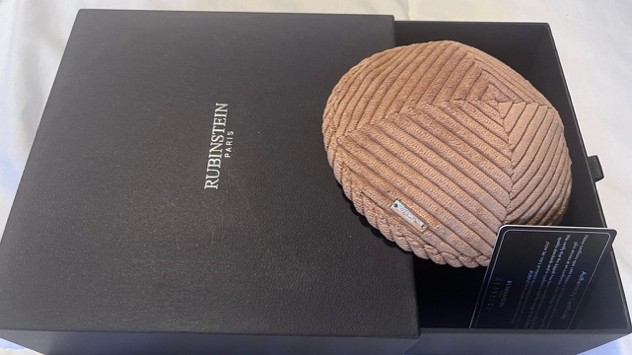
So what kind of Jew wears an $85 yarmulke, and what kind of Judaism demands it? These questions gnawed at me when I first learned about Rubenstein Paris, a new kippah couturier whose ads found me on Instagram. Available in a range of expensive-looking solid colors (copper, cream, sapphire) and fabrics (velvet, corduroy, even horsehair), “…these kippahs are here to replace your tattered souvenirs,” the ads said. “Everybody’s just walking around with their kippot from — I don’t know, Mendel and Rachel’s wedding, 2019,” Jonathan Hirsch, Rubenstein’s German-Israeli founder, told me recently. “It’s such a sacred item. Why aren’t there beautiful yarmulkas?
He’s onto something, I thought. Even as an image-conscious, Shabbat-observant millennial, I had largely neglected the yarmulke; when I wanted to look sharp, I ditched it. But when I had to clip up, I made do with whatever I had lying around. Hirsch offered to send a freebie, but at $85, accepting it felt compromising. The loaner we agreed to instead came in a branded drawstring bag, which was accompanied by a sleek black storage box. Although I’d secretly hoped for the horsehair model, the kippah Hirsch sent was more utilitarian: Ribbed velvet, golden brown, with the rise and structural integrity of one of those dome-houses you see in Architectural Digest. Velvet piping twisted around its circumference; its cloth inner lining depicted a globe and a shofar. I put it on.
The story of the kippah begins in the Talmud, when 3rd-century sage Rav Huna proclaimed that he never walked more than four cubits without his head covered to symbolize that the divine presence was always above him. After rabbinic law codified the practice in the 1500s, the kippah evolved into a marker of Jewish cultural mores. For example, 20 years ago, most Modern Orthodox boys wore black suede kippahs, but today, suede is disappearing, replaced by black velvet.
But it’s a fraught moment to be displaying any marker of Jewish identity. Wearing a kippah in public makes you subject to a certain type of attention these days: The glare of being Jewish at a time when antisemitism is on the rise. Hirsch, who is 29 and lives in Berlin, knows this firsthand — these days he doesn’t feel safe wearing a kippah in public. And yet there is a Renaissance in Judaica today driven by new designers and younger consumers finding joy in their heritage. First, ironically, then with some resignation, I found that the Rubenstein was the only kippah I wanted to wear — my fancy kippah became my everyday kippah. Putting it on was a daily treat — I was humored by the upgrade. I began picturing how gloomy and shallow life would be without it. I debated the unthinkable — ponying up to keep the loaner.
I was still conflicted about the idea of this object with sticker-shock. I put the question to Hirsch. There are very few ritual objects, he pointed out, from the kiddush cup to candlesticks to one’s tallit, that we pride ourselves on buying cheap. Why should kippot be the exception?
Hirsch was right, and I expected others to acknowledge my commitment and my sophistication. Only one person complimented me on it — my mother. Everyone else, I’m certain, was stealing covetous glances at my designer yarmulka. But I’m going to return it soon. The premium fabrics, the shofar in the lining, and the devotion it all symbolized were between me and Ha Shem.
By Lewis Keene
Get Social