New York City’s annual Israel Day Parade
New York City’s annual Israel Day Parade marched up Fifth Avenue on Sunday, May 31, with tens of thousands of people turning out for what organizers called one of the largest parades in the event’s history, a public show of Jewish solidarity when anti-semitism is rising around the world. Gov. Kathy Hochul, Sen. Chuck Schumer, Attorney General Letitia James, former mayors Eric Adams and Michael Bloomberg, and a long list of officials marched to underscore support for Israel.
Getty Images/Spencer Platt
France Reckons With Nazi-Looted Art In A New Paris Museum Gallery
 The painting shows a girl in a bonnet and her younger brother staring across the Normandy coast toward an unknown horizon. The artwork was acquired in Paris for Adolf Hitler, one of countless works swept up in the Nazi plunder. In May, the piece went on permanent display in a new room at the city’s Musée d’Orsay as part of France’s reckoning with Nazi-era looting. The gallery is given over to the orphaned masterpieces of the Nazi era — more than 2,000 works stolen and never claimed. The state holds them in trust for heirs who may yet come forward. The museum holds 13 of such works, including that pictured by Belgian artist Alfred Stevens.
Included in the display are works by Degas, Renoir, Cézanne and Rodin, appropriated from Jewish collectors and intended for the private collections of Hitler and his officers, also a museum of art that was never built. The works were discovered by an allied group known as the Monuments Men, whose sole duty was to recover stolen art.
According to Francois Blanchetiére, the Orsay’s co-curator of the gallery, “The consequences of the Holocaust must be repaired. There is no statute of limitations on these crimes.”
A California Forest Synagogue Embraces Nature-Based Spirituality
 On an unseasonably warm Friday evening, 40 people gathered for a Kabbalat Shabbat service in a grove of redwoods and California live oaks. A group of musicians led the congregation in singing Hebrew tunes as an owl made his presence known from above. The service was part of Makom Shalom, a forest shul that launched during the High Holidays last year and has grown to 83 adult members. Rabbi Zelig Golden leads the nondenominational congregation in rural West Sonoma County — an earth-based Judaism, where congregants are finding a spiritual home outside a traditional synagogue with environmental ideals at the core. “The Jewish soul comes alive in the natural world,” Rabbi Golden said.
Gaia Esensten photo
Can We Make God Speak Again? A 13-Year-Old Had The Answer
Jeffrey Salkin/For ‘Religion News Service’
One of my adult students recently asked me, “You know how God spoke to Abraham, Sarah, Isaac, Rebecca, Jacob, Moses, Isaiah, and the rest of the prophets? Why doesn’t God speak anymore?”
It is a truly good question. A quick answer: After Malachi, there was no more prophecy, and God stopped speaking. But the Talmud has a different answer: Even though Prophecy had ended by that time, the voice of God could sometimes speak to people in a bat kol, or a soft, quiet tone. God could speak to us in the voice of a young girl.
Which brings me to a great Jewish theologian. Some years ago in Hollywood, Florida, I was close to the family of 13-year-old Rebecca Adler. She became bat mitzvah under my tutelage, but for one exquisite moment, she became my teacher.
One day in our 7th-grade class, the kids were wondering aloud: “What would it be like if God could speak to us? Would it be all thunder and lightning, or even something more intense?”
In the midst of this conversation, Rebecca piped up and said, “Whenever we do a mitzvah, it is as if God is speaking to us.” Her words echoed one of the most important Jewish thinkers of modern times. The great theologian and social activist Abraham Joshua Heschel once said, “When we fulfill a mitzvah, God is revealed in our deeds; in the depths of our being, we perceive the Divine Voice.”
I first heard that teaching from a 13-year-old student, whose depth of faith could give shape to our own spiritual lives.
Unlikely Group Tended The Cemetery Of America’s Oldest Synagogue
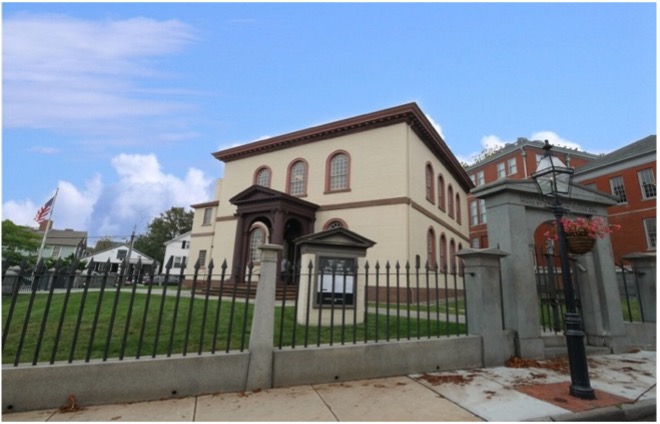 Jewish Cemetery Preserved by Christians and Jews
Newport, Rhode Island, had once been home to a thriving Colonial Jewish community — also the home of Touro Synagogue, the nation’s oldest surviving Jewish house of worship. But after the Revolutionary War and the city’s economic decline, that community largely faded. Yet the cemetery and the synagogue building remained.
The Jewish burial ground dated to 1677. In 1822, Abraham Touro left money for the upkeep of the cemetery, the synagogue (built in 1763), and the street on which they stood. Newport’s Town Council was authorized to use the interest for repairs.
When Henry Wadsworth Longfellow visited Newport’s Jewish cemetery in 1854, he wrote of the graves as “silent beside the never-silent waves.” He noticed, too, what endured there: “Gone are the living, but the dead remain,” he observed, “and they are not neglected.”
Newport’s preservation of Jewish sacred space was shared. Jews endowed these places and returned to bury their dead there. Christian officials repaired, protected, and publicly honored them. In this way, a Jewish inheritance was carried forward until communal life returned.
In 1883, Touro Synagogue was rededicated, and a new Jewish community was established in Newport. Yet, even in the years when the congregation was gone, the dead were not abandoned.
—Austin Albanese/The Forward
Random Reads
 The Sisterhood of Ravensbrück, Lynne Olson
The true story of how an intrepid band of Frenchwomen resisted the Nazis in Hitler’s all-female concentration camp. They risked death for any infraction, but that did not stop them from defying the SS at every turn.
A Fool’s Kabbalah, Steve Stern
In the ruins of postwar Europe, the world’s leading expert on the Kabbalah and Jewish mysticism goes on a hair-raising journey to recover sacred books stolen by the Nazis or hidden by the Jews themselves in secret places throughout the ravaged continent.
Sons and Daughters, Chaim Grade
This novel provides a glimpse of a way of life that is no longer — the rich Yiddish culture of Poland and Lithuania that the Holocaust would eradicate — by one of the 20th century’s pre-eminent writers of Yiddish fiction. It illuminates the clash between the secular world and the life bound by religious duty.
This 12-Year-Old Is Enchanting People With Her Yiddish Singing
Dinah Slepovitch. Photo by Zisl Slepovitch
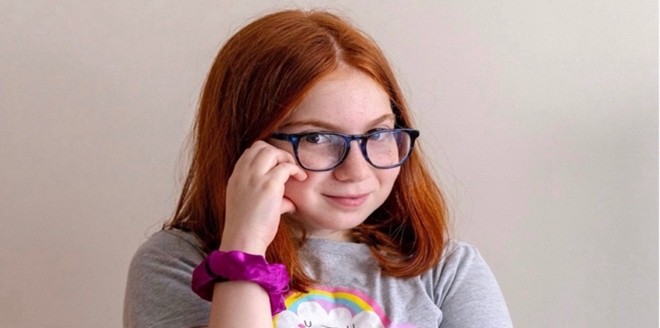 In summer 2020, when the world was in lockdown, I couldn’t stop watching a video that featured two young children — Dinah Slepovitch and Pinya Minkin — singing a Yiddish folk song about eating potatoes every day. The song felt a lot like life during COVID-19, even as it evoked what poor Eastern European Jews often ate in the past. I was enchanted.
The Yiddish language was still relatively new for me then, and I had no idea that Dinah — at the grand age of 7 — was already an experienced singer of Yiddish songs. At age 4, she performed at the Workers Circle Hanukkah concert in New York. She sings entirely from memory in perfect Yiddish and her father — klezmer musician, composer and Jewish music scholar Zisl Slepovitch — accompanies her on the keyboard or piano. Dinah and her father have made about 20 videos together over the past several years, showcasing a variety of Yiddish songs.
In 2025, 12-year-old Dinah gave the world premiere of “Afn taykhl sholem” (“By the river of peace”), composed by her father with words from a Yiddish poem by Boris Sandler. Father and daughter performed the song together at a gala in honor of Sandler’s 75th birthday. Dinah also debuted as a soloist with the National Yiddish Theater-Folksbiene during its Hanukkah program at Hebrew Union College. And she appeared in new videos of Yiddish songs, including the bittersweet “Zol shoyn kumen di geule” (“May the Redemption Come Soon”), composed after the Holocaust with words by the poet Shmerke Kaczerginski.
I recently spoke with Dinah and her father about the role of Yiddish songs in her life.
How did Dinah begin singing songs in Yiddish?
Zisl Slepovitch: I’ve been singing Yiddish songs to her since she was born. She naturally started imitating me, the way little kids do. We mostly speak Russian at home, because my wife and I grew up in Belarus. Of course Dinah speaks English at school, and English and Russian with her friends.
But Yiddish and Yiddish songs are part of our family life, and she soaked them up from her daily environment. She hasn’t been exposed to Yiddish in a systematic way, so she can’t converse yet like she does in Russian or English. But it’s clear how easily and naturally she sings in Yiddish.
Dinah, how do you learn all these Yiddish songs by heart? What’s your process?
Dinah Slepovitch: When we pick a new song to learn, my father sings it to me as many times as I need. I have a pretty good memory, so I start to remember the melody right away. Then we go over the words, translating them into Russian and sometimes into English. We also talk about what the song means, the kinds of emotions that it describes. Because I know so many Yiddish songs by now, a lot of the words are already familiar — more and more words over time.
What are your favorite Yiddish songs?
Dinah Slepovitch: “Shnirele Perele” is special to me, because I sang it in the first video that my dad and I made during COVID-19. And of course the song about potatoes is close to my heart, since that video was really popular and helped a lot of Yiddish fans get through COVID. I also love “Arum dem fayer” (“Around the Fire”). When I sing it, I’m calm and connected to the people singing with me.
What kind of reaction have you gotten to your videos?
Zisl Slepovitch: We’ve gotten a very positive reaction. I travel around the world because of my music work, and I hear from many musicians and Yiddish enthusiasts in other countries that they’ve watched the videos, often with their children. Yiddish teachers and teachers of Jewish music show them to their classes. It’s inspiring for students to see a child who loves Yiddish and sings it so comfortably.
Dinah, how do you feel when you sing for a live audience, especially in a big theater or auditorium?
Dinah Slepovitch: Nervous. But my mom helps me a lot. She’s my biggest cheerleader, and she’s always there with me backstage when I’m getting ready to perform. She helps me to calm down. Once I go out on the stage and start singing, I feel very happy.
Will you keep singing Yiddish songs for live audiences and making videos?
Dinah Slepovitch: Yes. As I learn more Yiddish, I’ll be able to sing more kinds of songs. I sing with the New York chapter of the National Children’s Chorus, which helps with singing technique. We sing in English, Spanish, Japanese, Hebrew, Hawaiian, Mandarin, Latin. The conductors help us pronounce the words correctly. I love singing in all kinds of languages. But Yiddish songs will always be special for me, because Yiddish is such a big part of my life.
[Click here for a performance. Click “skip” to avoid the ads]
Afn taykhl Sholem – Dinah Slepovitch -Boris Sandler / Zisl …
Get Social