3 years ago11 people were killed at the Tree of Life Synagogue in Pittsburgh’s Squirrel Hill
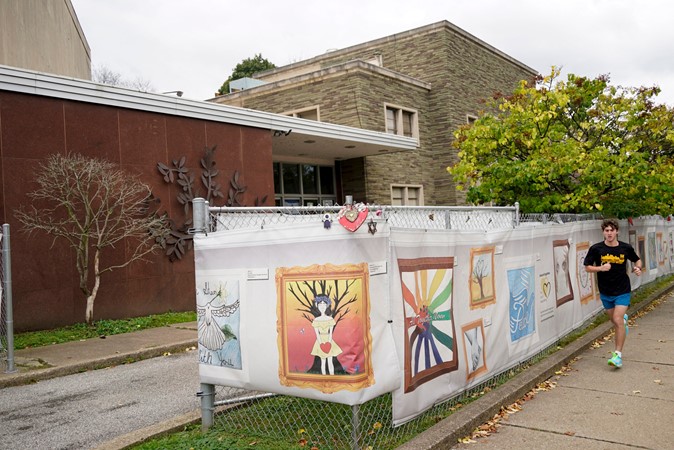
On Oct. 16, 2021, three years after 11 people were killed at the Tree of Life Synagogue in Pittsburgh’s Squirrel Hill neighborhood, a man jogs along the fencing outside the dormant building, decorated with artwork submitted by Pittsburgh area school students. Renowned architect Daniel Libeskind is among those working to transform the site to share space with the Holocaust Center of Pittsburgh. AP Photo/Keith Srakocic
Holocaust Museums Update Content In View Of Aging Survivors
With an urgency to preserve memory and modernize as the remaining Holocaust survivors enter their 80s and 90s, at least half a dozen Holocaust museums are being built or plan to break ground, according to an article in The New York Times.
Steven Spielberg’s U.S.C. Shoah Foundation, founded in 1994 to record survivors’ stories, is teaming with the Holocaust Memorial Resource and Education Center of Florida to build a museum in Orlando that will showcase the foundation’s library of 55,000 survivor video testimonies and also have high-tech virtual installations to appeal to younger people. Seventy six years after Auschwitz was liberated, there are an estimated 350,000 living Holocaust survivors, and the Shoah Foundation is scrambling to record their stories.
Of the 16 Holocaust museums in the United States, some are teaming with the Shoah Foundation and also looking to delve into related topics like injustice and bigotry in order to reach wider non-Jewish audiences by tackling topics beyond the Holocaust.
Other museums partnering with the Shoah Foundation include the St. Louis Kaplan Feldman Holocaust Museum and the Holocaust Museum LA. Those expanding their mission include the Holocaust Museum Houston and the Dallas Holocaust and Human Rights Museum. The City of Miami Beach and Greater Miami Jewish Federation aim to add to a Holocaust memorial, incorporating Shoah Foundation videos and an educational space.
80th anniversary memorial for victims of the 1941 Nazi massacre of Jews at Babi Yar Kyiv, Ukraine
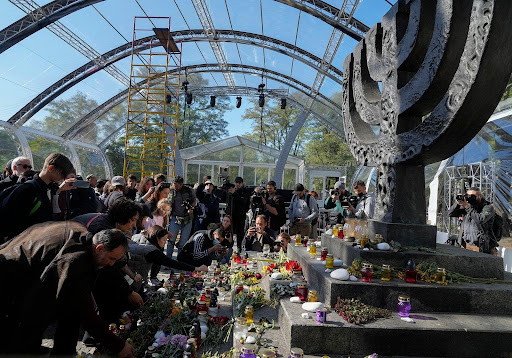
People pray at the 80th anniversary memorial for victims of the 1941 Nazi massacre of Jews at Babi Yar Kyiv, Ukraine. Babi Yar is the site of Massacres carried out by Nazi Germany’s forces during its campaign against the Soviet Union in WWII. The first and best documented of the massacres took place on Sept. 29 and 30, 1941, killing approximately 33,771 Jews. AP Photo/Efrem Lukatsky
Sharsheret Offers Week Of Programs About Breast/Ovarian Cancer
Sharsheret, a national nonprofit organization that focuses on helping Jewish women and their families cope with breast and/or ovarian cancer, has planned a week’s worth of programs, including a Shabbat program, cooking class, family activity, panel conversation and an exercise program, among others, to provide valuable information to women at-risk and their families. The programs will be offered online, from Friday, Oct. 8 through Saturday, Oct. 16.
For more information about viewing and participating in the programs, visit www.sharsheret.org/.
Heirs Compensated For Nazi-Looted Artworks In Liebermann Collection
A decade-lo ng dispute over a portrait of Max Liebermann’s wife, painted by the German Impressionist and confiscated by the Nazis from her home in Berlin in 1943, has been settled with a financial payment to the artist’s heirs, two great-granddaughters. In a joint statement with the heirs, the Georg Schäfer Foundation, which came to own the 1930 portrait and two other works from Liebermann’s collection, said an anonymous private donor had agreed to pay an undisclosed amount to the heirs in compensation for the three works. The foundation agreed that the provenance of the works will be clearly displayed in the Georg Schäfer Museum in Schweinfurt in northern Bavaria, which houses the foundation’s collection.
Among other claimants seeking restitution from the foundation are the heirs of Therese Clara Kirstein. The heirs say that a drawing by Adolph Menzel and a Liebermann study, once owned by Kirstein, were sold under duress shortly before her death or, more likely, confiscated and sold shortly after, The New York Times reported.
An Anne Frank Center Opens At The University of South Carolina
The red-brick Georgian-style home on a tree-lined street at the heart of the University of South Carolina campus has no sign posted yet. For the moment, it is as anonymous as the red-brick Dutch townhouse
where Anne Frank hid with her family from German soldiers.
Opened on the eve of Yom Kippur this year, the new Anne Frank Center is dedicated to studying the legacy of the German-Dutch writer whose famous diary chronicled the two years she spent hiding in a secret annex in Nazi-occupied Amsterdam. Frank is being memorialized in the heart of the South as part of an educational effort to stem not only hatred of Jews, but bigotry, discrimination and racism more broadly.
The center is the brainchild of Doyle Stevick, associate professor of educational leadership at the university and an expert on Holocaust education. The center’s 1,060 square feet of exhibition space is interspersed with photos, timelines and references to the segregated South.
With the opening of the center, funded by the Anne Frank House in Amsterdam, the university and private donations, Stevick hopes it cements the university’s commitment to inclusion and civil society.
What Kind of Bread Crumbs Will You Cast Adrift On Tashlich?
As a service to the congregation, every five years, The Shofar reminds the congregation to participate in tashlich, the symbolic ritual of casting away one’s sins by throwing crumbs of bread into a body of water. Some people have been known to ask what kind of bread crumbs they should throw. Herewith…
for ordinary sins, white bread
for exotic sins, French bread
for dark sins, pumpernickel
for complex sins, multi-grain
for tasteless sins, rice cakes
for sins of indecision, waffles
for sins committed in haste, matza
for sins under 18 minutes, Shmurah matza
for sins of chutzpah, fresh bread
for committing arson, toast
for committing auto theft, caraway
for being ill-tempered, sourdough
for silliness, nut bread
for not giving full value, shortbread
for excessive use of irony, rye bread
for telling bad jokes, corn bread
for hardening arteries, jelly doughnuts
for being money hungry, enriched bread
for war mongering, Kaiser rolls
for immodest dressing, tarts
for causing injury to others, tortes
for davening off tune, flat bread
for being holier than thou, bagels
for unfairly upbraiding another, challah
for trashing the environment, dumplings
for sins of pride, puff pastry
for sins of the righteous, angel food cake
for selling your soul, devil’s food cake
for substance abuse, stoned wheat
for heavy drugs, poppy seed
for petty larceny, stollen
for timidity, milk toast
for risking one’s life unnecessarily, hero
for being hyper-critical, pancakes
for political skullduggery, Bismarks
for over eating, stuffing bread
for gambling, fortune cookies
for abrasiveness, grits
for being snappish, gingerbread
for impetuosity, quick bread
for negligent slip ups, banana bread
for dropping in without warning, popovers
Get Social