Tony Roberts
Tony Roberts, the Hollywood and stage actor best known as the hero’s best friend in Woody Allen movies like “Annie Hall,” and who distinguished himself on the New York stage with two Tony Award nominations, died on Feb. 7 at his home in Manhattan. He was 85.
Other acting credits are “Hannah and Her Sisters,” “Play It Again, Sam,” “Don’t Drink the Water,” “How Now, Dow Jones,” “Serpico,” “The Sisters Rosensweig,” “Barefoot in the Park,” “The Taking of Pelham One Two Three,” and other appearances on screen and stage. His final screen role was as Max Kellerman, a wistful Catskills resort owner, in a 2017 television movie version of “Dirty Dancing.”
In an NBC interview recounted in his 2015 memoir, Do you know me?, a critic, impressed by — or concerned about — the number of television, movie and theater projects Mr. Roberts had going on, asked him if he ever took a vacation.
“No,” Mr. Roberts said. “I crack under leisure.”
Marion Wiesel
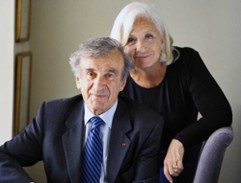 Marion Wiesel, who translated many books written by her husband, Elie Wiesel, including the final edition of his magnum opus, Night, and who encouraged him to pursue a wide-ranging public career, helping him become one of the most renowned interpreters of the Holocaust, died on Feb. 2 at her home in Greenwich, CT. She was 94.
Marion Wiesel shared her husband’s cosmopolitan knowledge of European culture and fluency in several languages. She quickly began translating his writings from French to English, ultimately working on 14 of his books.
Perhaps no single moment of Mr. Wiesel’s political career is so vividly recalled as his plea to Ronald Reagan, issued in the White House alongside the president and in front of TV cameras, not to visit the Bitburg military cemetery, where members of the SS are buried in what was then West Germany. “That place, Mr. President, is not your place,” Mr. Wiesel said. “Your place is with victims of the SS.”
“Those remarks had an editor: Mrs. Wiesel,” Alex Traub wrote in The New York Times. “There would not have been a Bitburg speech without Marion’s conviction,” the couple’s editor and friend Ileene Smith said. She called Mrs. Wiesel her husband’s “most trusted advisor.” Elie Wiesel Foundation photo
Mort Künstler
Mort Künstler, whose meticulously researched and dramatically composed paintings of American historical events, especially of the Civil War, made him one of the country’s most prominent historical artists, died on Feb. 2 in Rockville Center, NY. He was 97.
Mr. Künstler developed a sense of dramatic realism early in the 1950s as an illustrator for pulp novels and men’s adventure magazines. He refined his mainstream commercial appeal working for top ad agencies and magazines like National Geographic, where he learned the importance of conducting extensive historical research before ever dipping a brush in paint.
Mr. Künstler’s paintings have joined the permanent collections of dozens of museums, and he had scores of solo shows in galleries and museums across the country.
Harold Holzer, a Civil War expert and author, described Mr. Künstler in an interview as “both a scholar of the paintbrush, and a painter of scholarship…a master storyteller with an eye for color and character, drama and detail.”
Anson Rabinbach
Anson Rabinbach, one of the world’s leading experts of the Nazi era, died on Feb. 2 in Rome, where he was giving a lecture. He was 79.
Professor Rabinbach was among several young scholars in the early 1970s who attempted to bridge the gap between social history and intellectual history, especially in the realm of 20th-century Europe. Frustrated by a lack of places in which to express his views, in 1973, professor Rabinbach and three other academics — David Bathrick, Andreas Huyssen and Jack Zipes — founded the journal New German Critique, which became a leading outlet for scholars of 20th-century German culture.
Although he taught at Princeton, held top fellowship, and lectured around the world, Professor Rabinbach always considered New German Critique his intellectual home, a place where he could express his opinions about the left and the right.
Mel Bochner
Mel Bochner, an artist who produced often witty work, exploring the boundaries of art and the power of language in drawings, painting, photography, sculpture, printmaking, books, installations and public art — new ideas in conceptional art — died on Feb. 12 in Manhattan. He was 84.
“In 1970, I wrote on a gallery wall, ‘Language Is Not Transparent,’” Mr. Bochner told curators at the Art Institute of Chicago in 2022, when the museum held a retrospective of his work. It was a statement that all language has hidden agendas and motives. The first thing that power corrupts is language…My work doesn’t address political issues directly. But at the same time, I do agree with Charlie Chaplin: ‘If it isn’t funny, it isn’t art.’”
Marshall Rose
Marshall Rose, a real estate developer who was instrumental in reviving the New York Public Library on Fifth Avenue and transforming the adjacent Bryant Park from a mecca for drug dealers into a verdant Midtown oasis, died on Feb. 15 at his home in Manhattan. He was 88.
A chairman of the library’s board of trustees from 1990 to 1995, Mr. Rose, along with his predecessor, Andrew Heiskell, and Vartan Gregorian, the library’s longtime president, engineered the resurgence of the Beaux-Arts landmark on Fifth Avenue and the derelict greensward just to its west.
“He was an unstoppable force of nature when it came to protecting and building what the public needed from its library,” said Anthony Marx, who in 2011 succeeded Paul LeClerc as the library’s president.
Ken Rosenthal
Ken Rosenthal, who opened a bakery café near St. Louis, with sourdough bread as its star, and built it into a small chain that would become Panera Bread, died on Feb. 14 at his home in Scottsdale, AZ. He was 81.
Mr. Rosenthal’s detour from selling women’s dresses to selling baked goods proved a smart one. From 1987 to 1993, he and his three partners expanded the first café into a chain of 20 stores in Missouri and Atlanta. In 1995, the cafés were bought by Au Bon Pain, which changed the corporate name to Panera Bread. Panera currently has 2,230 restaurants in the United States.
Mr. Rosenthal explained his operating style when he talked to The Post-Dispatch in 1997. “I’ve always been best when I’m completely challenged,” he said. “When things get to be routine with me, I suppose I lose a little interest. I’m not a great operator. I’m a better pioneer than I am anything else.”
Get Social