Ruth Westheimer
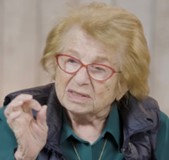 Ruth Westheimer, the diminutive guru of the American sexual revolution whose straightforward, matter-of-fact way of discussing the facts of life led to a career as a radio talk-show host, television personality, author and advice expert, died July 12 at her home in New York City. She escaped Nazi Germany in the 1930s and was one of the entertainment industry’s last survivors of the Holocaust.
The turning point for her career came in 1980. After giving a lecture to a group of New York broadcasters about the need for sex education programming, WNYN-FM offered her a 15-minute radio show called “Sexually Speaking.” Word spread quickly about the quirky, candid and informative radio host calling herself Dr. Ruth, who offered no-holds-barred advice on sex. By 1983, the program was an hour long and was drawing a quarter-million listeners weekly. The following year, it was syndicated across America. In 1983, “Sexually Speaking” made the leap to television.
As a 10-year-old, she was sent to Switzerland on a kindertransport. Later, she relocated to Palestine, also served in the Israeli army as a sniper. She arrived in New York in 1956. She never saw any of her family again. She learned that her parents were sent to the Lodz Ghetto and killed at Auschwitz.
Maxine R. Singer
Maxine F. Singer, a biochemist and federal health official who in the 1970s was instrumental in developing guidelines that protected the then-nascent field of biotechnology while calming fears that this new science would give way to the spread of deadly lab-produced microbes, died on July 9 at her home in Washington, DC. She was 93.
In a letter to the journal Science, Dr. Singer pointed out the risks to laboratory workers and called on the National Academies of Science to develop federal guidelines to protect them.
David Liederman
David Liederman, whose confections redefined the chocolate chip cookie and whose chain, David’s Cookies, grew to more than 100 stores nationwide, died on July 4 in Mount Kisco, NY. He was 75.
The unique feature of Mr. Liederman’s innovative version of the chocolate chip cookie was that it was not made with standard Toll House chocolate chips, but was studded with irregular pieces of dark
Swiss Lindt chocolate. He called his cookies chocolate chunk.
He opened his first cookie store, David’s Cookie Kitchen, on Second Avenue and 53rd Street in Manhattan in 1979. A chain of more than 100 David’s Cookies stores opened nationwide and in Japan. He sold David’s Cookies to Fairfield Foods in New Jersey in 1995 and retired from the company. He valued his cookie business at about $35 million in mid-1980s (about $102 million in today’s currency).
He also fronted several restaurants, including Manhattan Market, Chez Louis, Broadway Grill, Television City, and Restaurant Luna in Mount Kisco.
Dorothy Lichtenstein
Dorothy Lichtenstein, a prominent arts patron and widow of the acclaimed Pop artist Roy Lichtenstein, died on July 4 at her home in Southampton, NY. She was 84.
Described as an elegant, engaging woman and a gracious philanthropist, instead of seeking to sell the work left in her husband’s estate, she gave most of it away. Her donations consisted of paintings and sculptures, piles of sketchbooks, file drawers bulging with correspondence, and even the building in Lower Manhattan in which Mr. Lichtenstein’s last studio was located.
Through the Roy Lichtenstein Foundation, of which she was co-founder and president, the family donated 1,000 works to museums in the United States and abroad. The main beneficiary was the Whitney Museum of American Art, which in 2018 received a gift of some 400 works from Mr. Lichtenstein’s personal study collection — a mix of classic Pop paintings and sculptures and lesser-known material, like his early sketches of Native Americans and photographs he took of New York City building facades.
When she gave the studio building to the Whitney, “with characteristic self-effacement, she declined the Whitney’s offer to rename it in her honor,” The New York Times reported.
[The Shofar editor was particularly moved by tributes in her memory, yet not surprised. Although not close friends, I and Dolly Herzka, as she was known then, were college classmates and acquaintances, who many times talked together about college life and what we hoped would be fulfilling careers. Her beauty and grace were clearly evident even then. SMB]
Abe Krash
Abe Krash, who as a junior partner at the law firm of Arnold, Fortas & Porter played a critical role in Gideon v. Wainwright, the 1963 case in which the Supreme Court unanimously declared a right to counsel in criminal cases, died on July 6 at his home in Chevy Chase, MD. He was 97.
The Gideon decision is widely considered one of the most significant of the 20th century, part of a string of cases in which the Supreme Court under Chief Justice Earl Warren shored up Americans’ civil liberties in the face of the criminal justice system.
The case centered on a Florida man, Clarence Earl Gideon, arrested in 1961 for petit larceny, found guilty, denied a request for counsel, and sentenced to five years in prison. The Supreme Court found in Mr. Gideon’s favor in 1963. He was later retried and acquitted.
Mr. Krash became a partner in the law firm in 1960 and retired in 1998, having seen the firm grow from a dozen lawyers to more than 1,000. He handled some of the firm’s major clients, and was a mentor to generations of young lawyers, including Attorney General Merrick B. Garland, who said, “He never failed to emphasize to every new lawyer that Clarence Earl Gideon was the firm’s most important client.”
Martin Indyk
Martin Indyk, a former U.S. Ambassador to Israel under President Bill Clinton and former special envoy for Israeli-Palestinian negotiations under President Barack Obama, died on July 26 at his home in New Fairfield, CT. He was 73.
“From the Oslo process to the policy of ‘dual containment’ of Saddam’s Iraq and Islamic Iran, Martin left a deep and lasting imprint on the making and shaping of American Middle East policy,” said Dr. Robert Satoff, executive director of the Washington Institute for Near East Policy, an organization Indyk co-founded in 1985.
As recently as May, Indyk remained vocally engaged on the conflict in Gaza, posting on X a rebuke of Israeli Prime Minister Benjamin Netanyahu and claiming the Israeli government was leading Israel to “isolation and ruin” following a rejected peace deal.
David Levy
David Levy, a Moroccan-born Israeli who rose from ditch digger to Israel’s political heights, often embodying the resentments of Jews of North Africa and Middle Eastern origin, who felt ill-treated by Europe-rooted elites, died on June 2 at a hospital in Jerusalem. He was 86.
Mr. Levy was Israel’s foreign minister three times in the 1990s and often its deputy prime minister across two decades.
He entered politics, starting in the Israeli labor federation, Histadrut, and then in the right-wing nationalist Herut Party, a core component of what would become Likud. “He swiftly learned how to play the political game,” the New York Times said.
As he told his biographer, “I had to find a road that would lead to the corridors of power.”
Get Social