Dorothy Bohm
Dorothy Bohm, a photographer whose work fulfilled her “deep need,” she said, “to stop things from disappearing,” died on March 15 at a care facility in Northwest London. She was 98.
She was a teenager in Lithuania when her father gave her a Leica as she boarded a train to flee the Nazis. She studied photography in Manchester, England, and became a portrait photographer, switching later to black-and-white landscapes and street photographs that documented life in cities like London and Paris, also colorful abstract compositions and still lifes.
Her work has appeared in more than a dozen books and more than two dozen exhibitions. In 1971, she became associate director of the Photographers’ Gallery, one of London’s first galleries devoted solely to photography. For 15 years, she nurtured up-and-coming photographers. She produced a number of books, and was the subject of two documentaries.
Newton Minow
Newton N. Minow, who as chairman of the FCC in 1961 famously called American television “a vast wasteland,” died May 6 at his home in Chicago. He was 97.
To broadcasters who for years had enjoyed a cozy relationship with the FCC, Mr. Minow’s indictment opened a new era of regulatory pressures that for the first time stressed program content and public service. While the FCC had no authority to tell broadcasters what to air, Mr. Minow reminded them that it did periodically renew station licenses for the use of the public airwaves, and that it had the power to revoke them for irresponsibility.
Roy Saltman
Roy G. Saltman, the federal government’s leading expert on computerized voting whose overlooked warning about the vulnerability of punch-card ballots presaged the hanging chad fiasco in Florida and the disputed recount in the 2000 presidential election, died on April 21 in Rockville, MD. He was 90.
In a 132-page federal report published in 1988 and distributed to thousands of local voting officials across the country, Mr. Saltman, an analyst working for the National Institute of Standards and Technology, cautioned that the bits of cardboard that voters were supposed to punch out from their ballots, known as chads, might remain partly attached (hence, hanging), or pressed back into the card when the votes were counted. Either event would render the voter’s choice uncertain or, if the ballot appeared to be picking more than one candidate, invalid.
Mr. Saltman often said that there was no margin of error in voting. “An election is like the launch of a space rocket,” he often said. “It must work the first time.”
Menahem Pressler
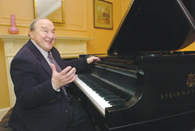 Menahem Pressler, the celebrated pianist who fled Nazi Germany in 1939 and who, after establishing himself in postwar America, co-founded the Beaux Arts Trio, died May 6 in London. He was 99.
The Beaux Arts Trio became the world’s reigning piano-violin-cello ensemble and dazzled audiences for a half-century. The group recorded nearly all the piano trio repertory — Mozart, Beethoven, Haydn, Schubert, Brahms, Dvorak, Saint-Saëns and others — through the boom years of LPs and into the digital age, garnering praise for redefining the perception of the piano trio and of chamber music itself.
In 2008, when the trio disbanded after 53 years, Mr. Pressler was 84, but he continued performing as a soloist and with ensembles. He also continued teaching at Indiana University, where he held the Charles H. Webb chair in music. That year, Mr. Pressler returned to Germany to observe the 70th anniversary of Kristallnacht. And in 2013, at 90, he made his debut with the Berlin Philharmonic, at a New Year’s Eve concert that was televised live throughout the world. [The New York Times photo]
Sam Zell
Sam Zell, the real estate tycoon who specialized in distressed assets and acquired The Chicago Tribune, The Los Angeles Times and other storied but troubled newspapers in a leveraged buyout of the parent Tribune Company in 2007, died on May 18. He was 81.
The son of Polish Jews who fled to America in 1939 as WWII engulfed Europe, Mr. Zell, an abrasive and eccentric Chicagoan, The New York Times said, reveled in testing the limits of business deals as well as motorcycles, amassed one of the nation’s largest portfolios of apartments, offices and commercial real estate, mostly by snatching up properties that other investors had snubbed as too risky or even moribund. In essence, he was a high stakes speculator who found opportunities where others saw only stress.
Mr. Zell was an active philanthropist, giving millions to the University of Michigan, Northwestern University, and the Wharton School of the University of Pennsylvania. He was also a major door to causes in Israel and to the American Jewish Committee, a Jewish primary school in Chicago named for his father, and other cultural and educational institutions.
Rachel Pollack
Rachel Pollack, a prolific writer about tarot and an early activist for transgendered people’s rights, died on April 7. She was 77.
Admired for her science fiction and fantasy writing in novels and comic books, she began speaking out for transvestites, transsexuals and drag queens at a time when the trans community was largely unseen, said Religion News Service. “I hope that Rachel’s legacy both as activist and mystic will be a serious commitment to playfulness and generosity of spirit,” said Roz Kaveney, a writing colleague.
Emily Fisher Landau
Emily Fisher Landau, a New Yorker who used a Lloyd’s insurance settlement from a spectacular jewel heist in her apartment to found what would become one of America’s premier collections of contemporary art, died on March 27 in Palm Beach, FL. She was 102.
From 1991 to 2017, Ms. Landau opened her collection of 1,200 artworks to the public in the Fisher Landau Center for Art, a repurposed former factory in Long Island City, Queens. In 2010, she pledged almost 400 works, then worth between $50-and-$75-million, to the Whitney Museum of American Art, where she had long been a trustee.
“I was devastated,” Ms. Landau said of the heist, but I decided that I didn’t want jewelry anymore. I now had seed money for an art collection,” thanks to the insurance settlement. In a way, the theft was one of the best things that ever happened to me, she said. Starting with a Calder mobile and works by Josef Albers, she went on to buy works by Matisse, Mondrian, Jean Arp, Mark Rothko, Franz Kline, Paul Klee, Louise Nevelson and Lucas Samaras.
Beyond the Whitney, she sat on committees at the MOMA and on the boards of the Georgia O’Keeffe Museum and SITE Santa Fe museum, both in New Mexico. For her support of its cultural institutions, the French government inducted her into the Order of Arts and Letters as a chevalier.
Outside the art world, she established the Fisher Landau Foundation for research on dyslexia and the Fisher Landau Center for the Treatment of Learning Disabilities at the Albert Einstein College of Medicine in the Bronx.
Her daughter, Candia Fisher, told The New York Times that whenever she spotted a woman wearing expensive jewelry, she would say, “That could be art on the walls.”
Get Social