From the Rabbi

“A Conversation between Truth and Peace”
Crossing the United States is fascinating, whether by air, auto, water, or train, as I did it this time. I was traveling to my cousin David’s wedding in Ventura, California, and I decided to take the scenic route. It was a different experience. No need to pack and unpack. The food was good, and the company was interesting. We stopped in some of the small towns, usually in the “flyover states.” It took four days and three nights from Penn Station in New York City to Union Station in Los Angeles, giving me ample time to think and muse, especially as it wasn’t easy for me to sleep in a bouncy and rattling train.
One of the memorable experiences was a two-hour conversation with a young Amish man I befriended in the café car as we were crossing the Colorado mountains. Jonas was traveling with his wife and other family members from Indiana to Los Angeles, and eventually on to Tijuana, Mexico, where he could find cheaper dental treatment. (Amish are prohibited to fly, but boats and trains are permissible). I learned that the Amish have no concept of divorce or annulment. That made me think about Danielle and David’s wedding, and marriage in general. What really makes a bayit ne’eman– a faithful or a strong home?
Rabban Shimon ben Gamliel in Pirkei Avot, the Talmudic ethical tractate, says, “The world stands on three things: Justice, Truth, and Peace,” that humans operate between their need to live the truth and their need for peace, with justice in the center, balancing individual truth and the communal peace. Those who look for absolute truth may sacrifice peace, and those who look only for peace may sacrifice the truth.
The Talmud tells us that our first house, the Temple in Jerusalem, was destroyed because of arguments over the smallest things, the smallest letter of the law. They fought over the little pointy end at the top of the yod, the smallest Hebrew letter. In his 1878 poem, Judah Leib (Leon) Gordon — in the time of the Haskalah, the Jewish Enlightenment — criticizes the rabbis for paying too much attention to the letter of the law, while a woman remains aguna, chained to her abandoning husband. On the other hand, those who avoid any confrontation, may avoid the truth of reality, and perhaps push peace farther away.
In Parashat Naso in the Book of Numbers, we read the story of the woman whose husband suspects her of infidelity, and of the ritual she must endure — drinking the bitter water concocted by the High Priest in the Temple to prove her innocence (or guilt). Our rabbis explain that the bitterness of the water comes from dipping this very portion of the Torah into the water, allowing the ink to dissolve. However, the name of God is written on it, and it dissolves as well, something downright forbidden. But the Midrash explains that God loves the concept of shalom bayit — peace in the house — so much that He allows even His own name to be erased.
But which comes first, truth or peace? Well, truth must be at the core of everything. But we can at times fudge the truth for the sake of peace, such as telling a bride she is beautiful, even if that may not be so. In that case, one must first recognize the truth, but then immediately pursue peace. The Prophet Zechariah tells us that these are the things you are to do: “Speak the truth to each other, and render true and sound judgement in your courts that are just and lead to peace. Then, when both the truth and peace coexist, the days of mourning and fast will become celebratory days.”
Marriage is like boarding a train ride across the country. It keeps swinging and bouncing, rattling and shaking, while we try to enjoy the view and the company. Sometimes you have to get off the train, take a breather, but stay the course. As long as the conversation between truth and peace is maintained, we will arrive at our destination — a faithful and peaceful home.
May God bless us with peace,
—Rabbi Gadi Capela
“Graduation”
 Last Thursday, I was privileged to stand with more than 70 fellow graduates on the campus of the Jewish Theological Seminary, which this year celebrated its 130th commencement ceremony. Wolf Blitzer, the CNN anchor, delivered the commencement address, which offered inspiring personal stories about his Jewish upbringing. He also shared his observation regarding the surge in antisemitism, but was still hopeful about the Jewish future in America.
Reflecting on that experience, I was reminded of a message I wrote for the January 2023 issue of The Shofar, titled “Back to School.” I wrote about heading back to school and my first day back on JTS/Columbia campus after a decade, noting that I felt like a fish returning to water. In that message, I observed that “…the spirit of learning is the humility of the soul. Going back to school is a mindset, a way of life. It is also the way of light, a hunger for knowledge and a thirst for wisdom.” I quoted Mark Twain, who said “I never let my schooling stand in the way of my education.” That statement could not have been more true during the past year.
Since Oct. 7, education has shifted from inside the classroom to the outside. All of it was taking place in the “public square.” The whole campus and beyond becoming one big educational lab. The separate buildings and facilities did not separate us any longer. Students studying nuclear physics joined students focused on journalism and architecture to demonstrate, to protest, and to make an encampment.
Nobody expected the next developments. Seeing Hamilton Hall, where my classes took place, being taken over by students in the name of a political agenda means that the campus is no longer defined by its boundaries, even when the gates are locked. The real education, perhaps, was to realize how quickly things can escalate or deteriorate — like a sunny afternoon disrupted by heavy rain clouds, thunder, and lightning. On the beautiful campus of Columbia University, the stately old buildings steeped in history were giving birth to new realities.
In a year fraught with pain and anxiety, we need the light of education to see a way through the unforeseen challenges. As we approach Lag B’Omer, the holiday of great light and bonfires on the 33rd day of the 49 days between Passover and Shavuot, we can experience that light. On that day in ancient history, according to the Talmud, the 24,000 students of Rabbi Akiva stopped dying in a plague. But why did they die in the first place? The Talmud answers, because they lacked respect for each other. The light of education illuminates the main message, that respect for each other and fellow students is the first lesson.
Perhaps that is the meaning of graduation — to be given the principles to seek truth, to discern what is true and what is false but knowing that the ultimate truth hides in the method, in the process, in the attitude, in showing respect to everybody and everything that contributes to one’s education, on campus and beyond it.
As we witnessed on campuses across the nation, the Jewish world is under attack. The first step in repelling darkness is by coming together in an illuminating respect. May it be so.
May God bless us with a bright summer,
—Rabbi Gadi Capela
[Photo credit: Havi Miller]
Indigenous Jews on Columbia Campus
My experience at Columbia University before and after Oct. 7
It was a profound time to be on the Columbia University campus during the October 7th events and their aftermath. I returned to school to finish a master’s degree I started 10 years earlier and found myself in the middle of the Jewish people and Israel’s toughest battles.
I found out that in the frequently discussed notion of Jewish indigenousness to the land of Israel, the perception in the West is firmly set on Jews being white. Similarly, Israel being a “Western” country and is somehow a “white, settler-colonialist” and an “Apartheid State.”
This rhetoric is so commonplace, it has made it into literature published by Amnesty International, the Black Lives Matter Movement, and Critical Race Theory. It also inspired the curricula across the United States. Ironically, in Europe, Jews were considered insufficiently white. But when they arrived in America, right into the paradigm of black or white, Jews gradually were considered “white” and assimilated.
Following one of the big anti-Israel demonstrations on campus, my professor asked me to narrate my parents’ story of forced migration from Yemen as children in 1951. I said, “I wish someone told my parents when they were wandering on foot for over a year in the Arabian Desert, that they were colonial oppressors.” I realized that my classmates have never processed who lives in Israel and how they got there.
There is at be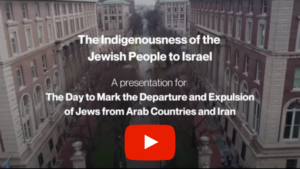 st, an informational disconnect between the reality of Mizrahi (Eastern) Jews and these demonstrably false notions. Despite millennia of documented history, there is a sheer lack of awareness of the indigenous Middle Eastern Jews, whose ancestors never set foot in Europe, and share genetic markers, physical features, language, and culture, with the surrounding non-Jewish populations. For this reason, they are referred to as the “Forgotten Refugees.”
The story of the Forgotten Refugees, which is the story of most Jewish Israelis today, is commemorated annually on November 30. It is known as The Day to Mark the Departure and Expulsion of Jews from the Arab Countries and Iran. It tells the story of nearly a million Jews displaced from Arab countries as a consequence of the events surrounding 1948 and the establishment of the State of Israel.
In order to explain this critical piece of Jewish history, with help of other students and alumni, I created an educational event the following month, on November 30, 2023. [See attached video]
Furthermore, for the past 18 years I have been involved with interfaith teaching and traveling with Christians and Muslims around the world. Our message all along has been that the conflicts in the Middle East, which are in no doubt influenced by geopolitical, economic, and other reasons, are essentially motivated by religious convictions. Therefore, interfaith dialogue and activism are key to the promotion of peace in the region. I would like to turn the journey of the Forgotten Refugees into a roadmap to peace in the Middle East.
Pursuing peace goes hand in hand with truth and justice. I hope to open a window into the context of Mizrahi communities within the story of the Jewish people. Tracing it through ancient manuscripts, I would like to show the diverse face of the Jewish people and the tapestry of Israeli society.
Columbia University accepted my proposal to make November 30th an annual affair on campus. I will use the next few months to plan the next event in November 2024. The goal is to provide a comprehensive understanding, aiming to educate and prevent future conflict arising from ignorance, and to amplify the often forgotten and unheard voices of the indigenous Middle Eastern Jews and their descendants.
Get Social