Shul News & Notes
Bonfire At The Parsonage Illuminates Shul’s Lag Ba’Omer Observance

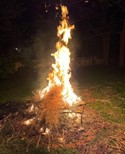 To observe Lag Ba’Omer, Rabbi Gadi invited shul members to the parsonage on Monday, May 8, at nightfall, to enjoy refreshments, camaraderie, and a warm and welcoming bonfire he tended with Francis DuBois at a firepit on the rear property. And what a blaze it was!
Lag Ba’Omer is a holiday celebrated on the 33rd day of the Omer, a Hebrew word for a specific measurement unit. Counting the Omer spans a 49-day period, beginning on the second day of Passover and ending on Shavuot. This ancient custom, linking the Exodus from Egypt with the giving of the Torah at Mount Sinai, reminds Jewish people that redemption from slavery wasn’t complete until they received the Torah.
Strict observance during the counting of the Omer forbids marriage and other celebrations — also haircuts — but on Lag Ba’Omer, restrictions are lifted and, traditionally, friends and families gather for large bonfires, which many believe represent the light of the Torah.
SMBloom photos
When Spring Comes, What Does The TOI Do? Mulch. Compost. Plant.
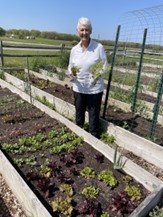 The Shofar heard this week from shul member Veronica Kaliski on behalf of the TOI, the Tikkun Olam Initiative. This shul-sponsored group maintains several beds at Common Ground, a shared site where community groups can garden, and where the TOI raises crops to be donated to CAST.
According to Veronica, the TOI has been hard at work in the garden: mulching, composting and planting. Planting what? From arugula to zucchini and all manner of veggies in between: peas, carrots, chard, collards and radishes for now — cool weather crops. Later, with good sun, there’ll be eggplant, squash and peppers, she said. In fact, if the warming trend continues, lettuce might be ready for harvesting at the moment this article is being read.
Those interested in planting and maintenance of the Common Ground beds, or in planting at home on behalf of the TOI and CAST, can contact the shul at ctigreenport@gmail.com with a message for the TOI.
Pictured, Adrianne Greenberg spent an afternoon encouraging little plants to grow and to flourish. Other shul members working for the TOI are Tom Byrne, Susan Rosenstreich, Madelyn Rothman and Cookie Slade. Veronica Kaliski photo
GHS Students Discuss Holocaust Museum Trip At Shabbat Service
 Four students from Greenport High School — Allie, Bray, Daniel and Sam — their teacher, Brian Toussaint, and the principal of the high school, Gary Kalish, were guests at the shul’s Shabbat service on Friday, May 5. The students, having visited the Museum of Jewish Heritage in New York City as the culmination of their social studies unit on the Holocaust, offered to share their learning in connection with that dark period in history and their personal reactions to what had occurred.
As it happened, the GHS curriculum dovetailed with the Yellow Candle Project at our shul, first introduced last year by shul member Chuck Simon and coordinated this year, in part, by shul member Tom Byrne. Funds donated to the project by shul members and friends were used to help sponsor the bus trip to the museum’s exhibit titled “The Holocaust: What Hate Can do.” The students’ collective aversion to the Nazi-led events during WWII and their appreciation to shul members for “punctuating the learning experience with the museum trip,” the school principal said, were evident throughout the presentation. [Those who have not yet contributed to the project may still do so.]
Allie pointed out the “devastating effects” of intolerance, noting how the opportunity to hear testimony from a Holocaust survivor had resonated with her understanding of that time.
Bray appreciated the museum’s focus on the prisoners’ individual stories, and how those stories had provided insight into each one’s personality.
To Daniel, the ability of the prisoners to “cling to hope” in the face of evil, even during a death march, he said, made a lasting impression.
Sam acknowledged a better understanding of those events, noting that “the world is a better place today,” and his hope that it will remain that way.
Following their individual commentaries, the students initiated a back-and-forth with shul members about freedom, the responsibilities of power, and antisemitism in the world today. As shul president Judith Weiner pointed out, “You are the future policymakers and parents. With your awareness of the evils of the past, you can change the future.” [Photo courtesy The Museum of Jewish Heritage]
Cast Invites All To A Playreading On Sunday, June 11, At 1 p.m.
 “We Call It Whiskey,” a one-act comedy by Chuck Simon, will be presented as a reading on Sunday, June 11,
at 1 p.m. — in-person at the shul and also on Zoom. (Note: the play follows shortly after the Congregation meeting and election of officers, which will take place at 10 that morning.) So, after a quickie lunch, hurry to the shul or click on Zoom for a fun theatrical afternoon. Cast: top row, from left, Stephen Meshover, producer-director-playwright Chuck Simon, Helaine Teperman; middle row, from left, Andrea Blaga, Adrianne Greenberg, Ron Rothman; bottom row, Tom Byrne and Rosa Lee Emerson. Don’t be late… SMBloom screen shot
From the Shofar Editor…
An editor is known by many descriptive names, some nicer than others. Miriam Gabriel, my able colleague and proofreader, calls me “chief.” I like that one. Other names, clearly inappropriate for this family-focused publication, typically are invoked by those whose submissions I have adjusted for clarity, rejected for such shortcomings as relevance or timeliness, or found so hopelessly error-ridden that only a total rewrite could save them.
An editor is the boss, the last word, the arbiter. He or she could be in charge of a big city newspaper with circulation numbers in the tens of thousands, huge staffs to manage, and reputations to uphold as well-regarded newsgathering organizations. On the other hand, editors may be positioned at the helm of, say, an unpretentious 20-page (give or take) online newsletter that is delivered free and is read, at best, by a few hundred folks because they willingly provided their email addresses. In either case, a publication without an editor invites stylistic chaos.
So what does an editor do? The editor of this newsletter, for instance, is the singular voice responsible for what is published, including noteworthiness of the story, quality of the writing, applicable illustration, and the design and layout of each page. It may not seem so to casual readers, but there is joy in this work. And that’s what I want to address in this particular space that, for the last three years — 36 issues — has been occupied by a monthly contributor of uncommonly articulate wordsmithing.
Shul president Judith K. Weiner submitted her “Swan Song,” she titled it, for the May issue of The Shofar, and I, among many, will miss her monthly submissions — her themes coherent and well developed, an extensive vocabulary able to single out the precise word to convey a thought, and the concentrated focus that corrals her text; it does not wander off, trail off, or take off in all directions. When she writes about matters that require your attention — such as the High Holiday Matching Gift Campaign — you know precisely what you are asked to do.
Thank you, Judith Weiner, for bold ideas well-conceived, for an approachable, conversational style, for adding strong writing to these pages, and for the joy this editor has experienced month after month in reviewing your columns. Speaking personally and for readers of The Shofar, we wish you well, and hope we will hear from you soon again on matters that engage you.
—Sara Bloom
Get Social