Shul News & Notes
The Tikkun Olam Initiative Asks You To Pot Seedlings For CAST Clients
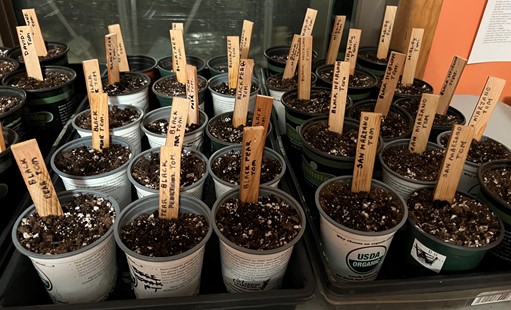 In the spirit of “Mighty Oaks From Little Acorns Grow” come these little pots with their hidden treasures. Soon, tomatoes and peppers will sprout, announcing readiness for the shul’s common ground plots, or distribution to CAST members. If you can designate some of your seedlings for CAST — favorites are lettuce, tomatoes, zucchini, cucumbers, peppers and eggplant — please email a message to the Tikkun Olam Initiative at ctigreenport@gmail.com/. Other TOI donations this month are pasta-makings and chickens. Cookie Slade photo
Oculus: Eye On The Arts/A Communal Activity
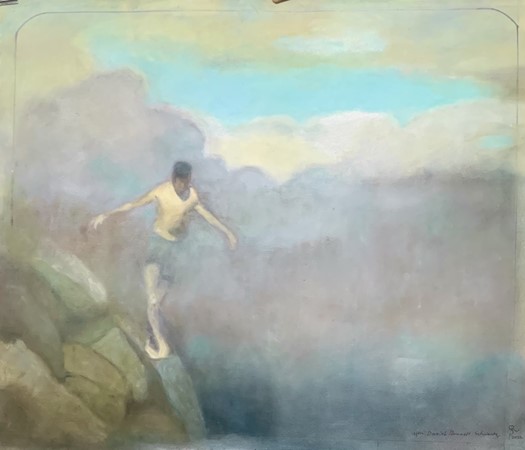 This month’s Oculus column features an oil on Arches paper (22×25) done some years ago by Saul Rosenstreich, after a work by Daniel Bennett Schwartz (1929-2020), a prolific New York illustrator. Copying masterworks long has been used to teach painting skills, Saul explained, feeling that this piece — a compelling mix of representation and abstraction, featuring a lone Everyman negotiating the edge of a precipice, his arms outstretched to aid his balance, his feet in some balletic position, Saul said — illustrates a tense situation, yet is upbeat and hopeful.
Coming upon the unfinished work recently, he experienced a eureka moment — that the piece speaks to the mood of the pandemic — that we, too, are in a tense situation, but by staying alert and focused, we will not fall into the abyss. Saul added the final brush strokes, and signed his painting in the convention of copied works: “After Daniel Bennett Schwartz, then added his own signature.
“It will now take its place on the Shehecheyanu Curtain,” Saul said.
May this piece inspire others to illustrate through literature and art their thoughts about the Covid pandemic. For more information about the curtain and how to contribute to it, email Saul at ctigreenport@gmail.org.
The Nomadic History Of The Sarajevo Haggadah: A Passover Story
 To highlight the holiday of Passover this year, The Shofar brings you an unusual story — the nomadic history of the Sarajevo Haggadah, one of the oldest Sephardic Haggadahs in the world, having originated in Barcelona around 1350. The Haggadah currently is owned by the National Museum of Bosnia and Herzegovina, its monetary value estimated at about $7 million.
The Haggadah is handwritten on bleached calfskin and illuminated in copper and gold. It opens with 34 illustrated pages of key scenes in the Bible, from creation through the death of Moses. Its pages are stained with wine, evidence that it was used at many Passover Seders. The Haggadah is included in UNESCO’s Memory of the World Register.
What draws the inquisitive to the story of this Haggadah is the many close calls it survived. Historians believe it was taken out of the Iberian Peninsula by Jews who were expelled by the Alhambra Decree in 1492. It remained hidden for centuries, but notes in the margins of the Haggadah indicate that it surfaced in Italy in the 16th century, and was ultimately sold to the National Museum in Sarajevo in 1894 by Joseph Kohen, although little is known about Kohen or how he came into possession of the document.
During World War II, the manuscript was again hidden, this time from the Nazis by the museum’s chief librarian, Derviš Korkut, who smuggled the Haggadah out of Sarajevo. Korkut gave it to a Muslim cleric who hid it in a mosque. In 1957, a facsimile of the Haggadah was published by Sándor Scheiber, director of the Rabbinical Seminary in Budapest.
In 1992 during the Bosnian War, the Haggadah manuscript survived a museum break-in. During the investigation, police discovered it on the floor with other items the thieves believed were not valuable. It was hidden again in an underground bank vault during the Siege of Sarajevo by Serb forces. To quell rumors that the government had sold the Haggadah in order to buy weapons, the president of Bosnia presented the manuscript at a community Seder in 1995.
In 2001, concerned about the deterioration of the Sarajevo Haggadah, which was then stored in a city bank vault under supposedly less than ideal conditions, Dr. Jakob Finci, the head of Sarajevo’s Jewish community, appealed to Jacques Paul Klein, the special representative of the Secretary General and Coordinator of United Nations Operations in Bosnia and Herzegovina, for his assistance in ensuring the preservation and restoration of this priceless historical treasure. Klein quickly agreed to help by developing a plan to secure the required funding, identify an internationally recognized expert to undertake the restoration, and make space available in the United Nations Headquarters building, where the restoration efforts could begin.
However, when the project became public knowledge, some local Bosnian officials were reluctant to support it. But once President Itzobegovic was informed of the obstructionism and advised that the international community likely would take a dim view of the lack of cooperation in the restoration efforts, the way was cleared for the restoration project to begin. Jacques Paul Klein reinstated an international campaign to raise the required funding. Contributions came from individuals, institutions, and governments around the world. With funding in hand, a climate-controlled room was refurbished in Sarajevo’s National Museum to house the Haggadah as the centerpiece, surrounded by documents of the Catholic, Orthodox and Muslim faiths.
On December 2, 2002, the vault room was dedicated by the special representative of the Secretary General in the presence of senior Bosnian government officials, the diplomatic community, the international media, and the public. The Sarajevo Haggadah and other sacred and historical religious documents had, at last, found a worthy home.
In 1985, a reproduction was printed in Ljubljana, with 5,000 copies made. The National Museum subsequently authorized the publication of a limited number of reproductions, and in May 2006, the Sarajevo publishing house, Rabic Ltd., announced the forthcoming publication of 613 copies of the Haggadah, alluding to the 613 mitzvot. The copies are on handmade parchment that attempts to recreate the appearance of the 14th-century original.
A copy of the Sarajevo Haggadah was given to former British Prime Minister Tony Blair by the Grand Mufti of Bosnia and Herzegovina, Mustafa Cerić, during the awards ceremony for the Tony Blair Faith Foundation’s Faith Shorts competition in December 2011. The Grand Mufti presented it as a symbol of interfaith cooperation and respect. The Grand Mufti presented another copy to a representative of the Chief Rabbinate of Israel during the interfaith meeting “Living Together is the Future,” organized in Sarajevo by the Community of Sant’Egidio.
In October 2012, the Haggadah’s future was left in limbo, following a drought in funding for the National Museum of Bosnia and Herzegovina, which had shuttered its doors in bankruptcy. However, in September 2015, following an intense campaign for funding, the museum reopened, and the Haggadah is again on display.
The Shofar is indebted to shul member Francis Dubois for sharing the story of the Sarajevo Haggadah and its survival. Many individuals recognized and protected this treasured artifact of Jewish history, including his friend and United Nations colleague, Jacques Paul Klein.
A Passover Memory
Decades have come and gone since the Passover holidays in my memory, yet I recall them in vivid detail. All the family is gathered — my husband and our children, my husband’s mother, his brother and family, my brother and family. We are seated in the dining room of our house on a bucolic street in Westchester County. The table is set with care, the wine is poured, the matza distributed, and all of us are dressed befitting the occasion. My father is seated at the head of the table — a place of honor — the trappings of the Seder service before him as he tells the ancient story and performs the ceremonial rituals.
The scene is hardly unusual, likely repeated in Jewish homes throughout the world. And yet, I suspect ours included a different and, to others perhaps, an insignificant component — but one important to me. Every year, at the conclusion of the recitations, my father would turn to me and say, “Daughter, you may serve the festive meal.”
My father was a formal man, that statement much in character for him. Others may find it an odd way to say, “Let’s eat.” But I loved the way my father phrased it, and I would wait for it each year. I wouldn’t dream of serving until I had heard my father’s instruction.
The year after my father died, my husband is seated at the head of the table — a place of honor — the trappings of the Seder service before him as he tells the ancient story and performs the ceremonial rituals. We are seated in the same dining room of the same house on the same bucolic street in Westchester County. The table is set with care, the wine is poured, the matza distributed, and all of us are dressed befitting the occasion. Yet it isn’t the same for me. Not until…
At the conclusion of the Seder service, my husband pauses for a breath. He closes the Haggadah, gazes at me seated opposite him at the end of the extended dining table. He smiles and says quietly, “You may serve the festive meal.” Welcome, Father. I’m so glad you have joined us for Seder this year.
—Sara Bloom
The Shofar invites readers to submit memories and anecdotes illustrative of Jewishness in their lives. Email copy to the editors at ctigreenport@gmail.com/.
‘Beyond Dispute’ Course To Begin Next Series on Sunday, March 27
 The spring semester of the JTS “Beyond Dispute” course will debut on Sunday, March 27. All classes are held on Sundays, from 11:30 a.m. to 1 p.m., on Zoom. Congregants and friends not previously registered are invited to audit any session.
Part III: Disputing the Essence of Judaism
“This series fits nicely with the spring holiday of Passover,” says Rabbi Gadi Capela, facilitator of the “Beyond Dispute” course. “Each class relates to topics we should contemplate before the holiday that celebrates the birth of the Jewish people.”
- March 27: What Defines Our Relationship with God? A Tale of two Covenants
- April 3: Does the Torah Contain Everything We Need to Know? The Maimonidean Controversy
- April 10: Is Judaism a Religion of the Heart or the Mind? Hasidism and its Opponents
Part IV: Disputing the Jewish Future
This session will begin on the Sunday following the second Passover seder.
- April 24: How Much Should Tragedy Define Us? The Holocaust in Contemporary Jewish Life. (Five days before Yom HaShoah)
- May 1: Can Commitment and Critique Coexist? Teaching Israel in the 21st Century. Israel Internal Relations/Part 1 (Four days before Yom Hazikaron and five days before Yom Ha’atzmaut)
- May 8: Can Commitment and Critique Coexist? Teaching Israel in the 21st Century. Israel External Relations/Part 2 (Four days after Yom Ha’atzmaut)
- May 15: What Do We Mean by Jewish Continuity? The Legacy of ‘Be Fruitful and Multiply.’ (Five days before Lag Ba’omer, which commemorates the end of a plague and the return to life.)
Get Social