Powerful Support For The Israeli Hostages Staged In Tel Aviv

Empty chairs at a Shabbat table outside Tel Aviv’s Museum of Art…one for each of the Israeli citizens held hostage in Gaza by Hamas.
It’s Not About Jews Or The Shul, But The Editor Loves This News…
 Giant pandas from China could be arriving in the United States again soon. According to The New York Times, Beijing is planning to continue its panda diplomacy with Western countries, a statement from the Chinese Embassy to the United States said.
The China Wildlife Conservation Association has reached agreement with the San Diego Zoo in California “on a new round of international giant panda conservation cooperation,” according to the statement. The agreement keeps alive a more than five-decade tradition of China lending pandas to American zoos in a gesture of friendly diplomacy between the two countries. China is also negotiating with the National Zoo in Washington, D.C.
The San Diego Zoo is “taking important steps to ensure we are prepared for a potential return,” a statement by Dr. Megan Owen said. Dr. Owen is vice president of conservation science at the zoo.
Pandas in the wild live in forests in the mountains of southwest China, where they subsist on bamboo, of which they need between 26 and 84 pounds daily.
The Forward’s Best Jewish Books of 2023: How Many Have You Read?
- We Could Have Been Friends, My Father and I: A Palestinian Memoir, Raja Shehadeh Father and son lawyers share goals, but are unable to appreciate each other’s politics.
- A Day In The Life of Abed Salama, Nathan Thrall. An account of daily life in the occupied West Bank.
- Enter Ghost, Isabella Hammad. A West Bank production of Hamlet explores the challenge of theater-making under occupation.
- Land of Hope and Fear, Isabel Kershner. A mosaic portrait of Israeli society at the height of Israel’s protests against the judicial overhaul.
- The Heaven And Earth Grocery Store, James McBride. A saga about intertwined Black and Jewish communities banding together in rural Pennsylvania.
- Hope, Andrew Ridker. A send-up of a seemingly perfect Boston Jewish family as it unravels over the course of a year.
- The Postcard, Anne Berest. Part fiction, part memoir, a mystery of four ancestors murdered at Auschwitz.
- The Best of Everything, Rona Jaffe. A reissue of the 1958 cult classic: Five young secretaries trying to make it in New York City.
- Lies and Sorcery, Elsa Morante. Available in English this year, these stories explore women’s inner lives.
- The World And All That It Holds, Aleksandar Hemon. The life of a Sephardic Jew upended by the start of WWI.
- I Must Be Dreaming, Roz Chast. The New Yorker cartoonist produces an illustrated catalogue of her dreams.
- The Cost Of Free Land, Rebecca Clarren. Journalist explores how her Jewish ancestors displaced the Lakota for settlers like her family.
- Fatherland, Burkhard Bilger. The New Yorker writer investigates his grandfather’s time as a Nazi Party chief in France.
- Portico: Cooking And Feasting In Rome’s Jewish Kitchen, Leah Koenig. Celebrating Shabbat in Rome, a Jewish food scene distinct from Ashkenazi and Sephardic cousins.
- The Everlasting Meal Cookbook, Tamar Adler. An alphabetized lexicon of leftovers and how to use them, including spare fish heads…
Iowa Judge Blocks Parts Of State Book Ban Law; Wiesel’s Night Saved
A federal judge in Iowa has blocked much of a state law forbidding school libraries from stocking books depicting “sex acts,” in part because he said it was keeping a classic Holocaust memoir off shelves.
U.S. District Court Judge Stephen Locher granted a preliminary injunction against the law, Iowa Senate File 496, on Dec. 29, just before a Jan. 1 deadline for schools to begin enforcing it. The “staggeringly broad” law, he wrote in his opinion, would prevent public schools from stocking “nonfiction history books about the Holocaust.” He pointed specifically to Elie Wiesel’s Night as an example of a book that could be caught in the dragnet.
Other Jewish books have been affected by the law are Maus, Art Spiegelman’s graphic Holocaust memoir, and Judy Blume’s Are You There, God? It’s Me, Margaret.
The injunction represents a major blow to efforts by conservative legislators in Iowa to import a national effort to purge school libraries of books they consider inappropriate. The effort has focused on books about race and sexuality, but has also led to books dealing with Judaism and the Holocaust being challenged or removed.
Iowa’s Republican governor, Kim Reynolds, signed SF 496 into law last year along with other culture-war legislation targeting transgender athletes and student pronouns in schools. Challenges to similar laws are winding through courts in Texas and Florida.
Bushwick Mural Shows An Israeli And A Palestinian Boy Embracing

Amid Israel’s war with Hamas in Gaza, two boys — one Israeli and one Palestinian — act as symbols of a peaceful future in a new mural painted on the side of the building at 49 Wyckoff Avenue in the Bushwick section of Brooklyn. The mural was intended to channel a sense of hope, said Michelle Mayerson, who helped organize and commission the work, executed by a Chilean street artist who goes by the name De Grupo.
Three Top University Presidents Testify About Antisemitism On Campus
Penn President Resigns After Remarks At Congressional Hearing
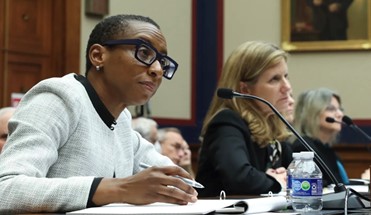 Liz Magill, president of the University of Pennsylvania, resigned on Dec. 9, four days after her response to a question about antisemitism posed to her and two other university presidents at a congressional hearing on Dec. 5. Her response angered many Jewish students, alumni and donors, and drew rebukes from Congress and the state’s Jewish governor.
Magill was the first college president to resign after protests and counter-protests over the Israel-Hamas war began roiling college campuses two months ago. The former dean of Stanford Law School, Magill was inaugurated as Penn’s president in 2022, and promised to protect free speech on campus. But like many college presidents, she has struggled since Oct. 7 — when Hamas attacked Israel and prompted a war in Gaza — to balance supporting free speech with concerns that some speech has gone too far.
At the House committee meeting on antisemitism, Magill had a chance to quell anger over her handling of protests on campus, as well as a Palestinian literary festival the university sponsored in September, which included a highly controversial guest list, many believe. Throughout the fall, many Jewish students and parents charged that anti-Israel rhetoric had created a hostile environment for Jews on campus, and had at times crossed the line into hate speech.
But in a moment that went viral, Magill hedged when asked by Rep. Elise Stefanik (R-NY) whether calls for genocide against Jews would constitute harassment on Penn’s campus, according to the university’s code of conduct. Stefanik asked the same of Harvard’s president, Claudine Gay, and also the president of MIT, Sally Kornbluth. All three presidents said the answer to Stefanik’s question would depend on context. The remarks by all three came off as insensitive.
Pennsylvania Gov. Josh Shapiro and Second Gentleman Doug Emhoff, both of whom are Jewish, were among those who criticized Magill for her statements in front of Congress, although neither said she should lose her job. “Frankly, I thought her comments were absolutely shameful,” Governor Shapiro said on Dec. 7. “It should not be hard to condemn genocide.”
“Liz Magill has voluntarily tendered her resignation as President of the University of Pennsylvania,” Scott Bok, chair of the university’s board of trustees, said in an email to university alumni. He also said that Magill would remain a tenured faculty member at the university’s law school.
McGill’s resignation followed days of calls for her ouster, including from the board of Wharton, the university’s business school. Additionally, more than 70 members of Congress called for the trustees of Penn — as well as Harvard and the Massachusetts Institute of Technology — to fire their presidents over their responses to antisemitism on campus, according to Reuters. All three faced enormous backlash from high-profile donors when they failed to condemn calls for the genocide of Jews.
Jonathan Greenblatt, CEO of the Anti-Defamation League, said on social media that Magill’s resignation was a “wake-up call.” “Campus administrators must protect their Jewish students with the same passion they bring to protecting all students,” he said.
In additional fallout, the president of Harvard apologized in a statement published in the student newspaper. “ I got caught up in what had become at that point an extended, combative exchange about policies and procedures,” Claudine Gay said. “What I should have had the presence of mind to do in that moment was to return to my guiding truth, which is that calls for violence against our Jewish community — threats to our Jewish students — have no place at Harvard, and will never go unchallenged.” Harvard expressed support for president Gay.
Additionally, Rabbi David Wolpe, a visiting scholar at Harvard Divinity School, who has built a reputation as one of the country’s most prominent rabbis and Jewish thinkers, resigned from an advisory committee on antisemitism Harvard had created in November. He cited “events on campus” and Gay’s “painfully inadequate testimony.” Harvard Hillel’s leadership also expressed a lack of trust in Gay’s ability to protect Jewish students on campus.
Sally Kornbluth of MIT responded to Stefanik’s question about whether a call for genocide against Jewish people would constitute harassment on MIT’s campus. Kornbluth said harassment would have to be targeted at individuals and pervasive, as well as require an investigation.
MIT’s governing boards released a statement on Dec. 7 standing behind the institute’s president amid backlash to her testimony.
[Pictured, from left, Claudine Gay, Harvard; Liz Magill, Penn; Sally Kornbluth, MIT. Axios photo]
Nationwide Swatting Spree Targets Nearly 200 Jewish Shuls, Institutions
A nationwide swatting spree [generating a law enforcement response under false pretenses] targeting nearly 200 synagogues and Jewish institutions over the weekend of Dec. 15 and 16 appears to have been a coordinated effort by an entity based outside the United States, FBI spokesman Cathy Milhoan said in a memo to law enforcement agencies.
A record number of incidents and false bomb threats were tracked by the Secure Community Network across multiple states, including California, Arizona, Connecticut, Colorado and Washington. None of the email threats involved any explosive devices or harm to congregants.
According to SCN, swatting incidents are up over 540% from 2022, with about 450 taking place this year. Thirty FBI field offices are investigating the threats.
Get Social