Yiddish Book Center Salutes Yiddish Women Writers
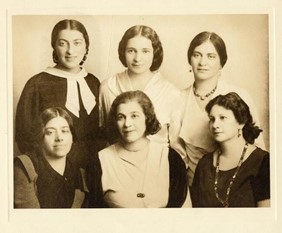 Yiddish women wrote poetry, short stories, novels, essays, memoirs, literary and cultural criticism, and autobiography, among other genres, exploring a wide range of topics — domesticity, desire, politics, the environment, and the ravages of war, and more. This March, in honor of Women’s History Month and of the vital contributions made by women writers to the field of Yiddish literature, the Yiddish Book Center has curated a diverse selection of items by and about Yiddish women writers.
These writers were brilliant and daring, complicated and compassionate, exuberant and quiet, and endlessly fascinating, the center says. Their work has much to tell us about the conditions and possibilities for women in the times in which they lived, and also modern Jewish culture, writing and publishing, immigration, and other topics. [Pictured, a Yiddish literary sisterhood, top row, from left: Malka Lee, Esther Shumiatsher, and Berta Kling. Bottom row, from left, Celia Dropkin, Sara Reyzen, and Ida Glazer.
To explore and listen to their stories, visit yiddishbookcenter.org/.
A Rare Treat: Making Snow Angels In Jerusalem
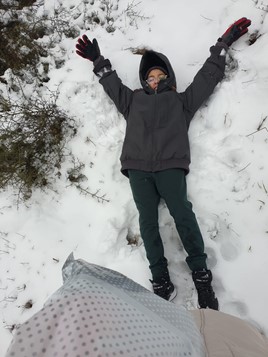 In most years, snowfall here in the Northeast is business as usual, but it is a rarity in Israel. Yet, on Jan. 27 this year, a rare snowfall hit parts of Israel and the West Bank, dropping 6 to 10 inches of snow on Jerusalem, and closing schools and businesses. This provided no disappointment to Rabbi Gadi’s nephew, Amit Buhbut, who provided proof of the phenomenon and his first experience making snow angels.
Historically, a snow event occurred in early January 1950 with a hailstorm in Tel Aviv and light snow in the mountains of the Upper Galilee and Jerusalem. A cold front spread throughout the country, and snow began falling in the mountains of Samaria and the West. On the 28th, it snowed in Haifa and piled up to a height of 8 to 12 inches, the largest snowfall registered since the beginning of meteorological measurements in 1870. No accumulation of snow has occurred in the Israeli Mediterranean coastal plain and the Dead Sea since the 1950 event. Snow is unknown in the vicinity of Eilat in the southernmost Negev.
‘The Marvelous Mrs. Maisel’ begins Season 4 on Amazon Prime Feb. 18
 It’s official. Amazon Prime Video has announced the Season 4 debut of “The Marvelous Mrs. Maisel” on Friday, Feb. 18.
The official trailer for the hit show finds Miriam “Midge Maisel (Rachel Brosnahan) sitting with her manager Susie (Alex Borstein) at their classic spot: the Stage Deli. The two are discussing Midge’s future as a comic after last season’s kerfuffle, which left all of us waiting to see how Midge would redeem herself.
“You know what’s great about me?” Midge asks Susie.
“Your humility?” Susie responds.
“No, it’s when I’m me. I will only do gigs where I can say what I want,” she tells Susie.
Susie argues, “That’s not how the business works,” to which Midge replies, “Then let’s change it.”
What will “changing the business” look like for Midge?
Researchers Find Ruins Of 16th-Century Jewish Community In Morocco
Researchers from Israel, Morocco and France have discovered remnants of a small Jewish community in the mountains of Morocco, Haaretz has reported. The ruins of the community’s synagogue in the small village of Tamanart, located on the outskirts of the Sahara desert, were found while conducting a preliminary survey of Jewish sites in the area. The researchers say Jews lived there from the 16th century until the early 19th century. They recovered scriptures, documents, and Kabbalist amulets from the synagogue’s genizah.
The discovery came weeks after King Mohammed VI of Morocco ordered the restoration of Jewish sites across the kingdom, and a year after Israel land Morocco agreed to formal diplomatic relations.
It is believed that Jews first established communities in Morocco more than 2,000 years ago. In the mid-20th century, the Jewish population reached a peak of 250,000. It is estimated that only 2,000 Jews remain today.
YIVO Institute Digitizes Its Archive Of European Jewish Life
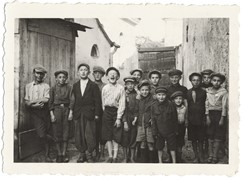 The YIVO Institute for Jewish Research has gathered, preserved and now digitized its pre-WWII papers, the culmination of a seven-year $7 million project. The archive is the largest remnant of Jewish life in Europe posted online for wide distribution and scholarship.
The collection of about 1.5 million pages includes working drafts by Hasidic philosopher Martin Buber; letters from Albert Einstein to Yiddish writers and actors; a diary of a young Theodor Herzl; business papers of the Rothschilds; songs; medical records; and the sermons of Rabbi Menachem Mendel Schneerson. Visit yivo.org for access.
11-Hour Standoff At A Texas Synagogue; Hostages Released; Suspect Dead
 An 11-hour standoff at a synagogue in Colleyville, Texas, ended late at night on Saturday, Jan. 15, with the rabbi and other hostages safe and the suspect dead, police said. The suspect had disrupted Shabbat-morning services as they were being livestreamed on Facebook, and held the rabbi and several congregants hostage until 9:30 p.m. local time, when the shul’s rabbi saw an avenue for escape and ushered everyone out safely.
The hostages included Rabbi Charlie Cytron-Walker and three congregants at Congregation Beth Israel, a Reform synagogue in the Dallas-Fort Worth suburb. More than 200 law enforcement officials were at the scene, and one hostage was released unharmed at about 5 p.m. local time. Once all the hostages were free, law enforcement entered the building, shots were fired, and the suspect was dead. It is unclear whether the suspect took his own life or was shot by police.
According to ABC, the suspect said he was connected to Aafia Siddiqui, a relative by marriage of Khalid Sheikh Muhammad, the chief architect of the Sept. 11, 2001 terrorist attacks. Aafia Siddiqui is serving an 86-year sentence in the Fort Worth area for attempting to kill American military personnel after she was arrested in Afghanistan in 2008 on suspicion of plotting attacks in New York. It has been suggested by the authorities that the suspect thought Jews might have connections in order to free Aafia Siddiqui.
Rabbi Rick Jacobs, president of the Union for Reform Judaism said that Jewish institutions take security seriously. A New York Times account on Monday, Jan. 17, pointed out that security instruction followed by the hostages at Congregation Beth Israel may have saved their lives. As a result of this recent security breach, Jewish organizations are encouraging synagogues to take steps to better secure their buildings and worshippers.
This is the latest in a string of attacks on synagogues in recent years. In October 2018, a shooter killed 11 people in a mass shooting at the Tree of Life Synagogue in Pittsburgh, the deadliest antisemitic incident in American history. In April 2019, a gunman killed one woman and injured others during a shooting at the Chabad of Poway that took place on the final day of Passover.
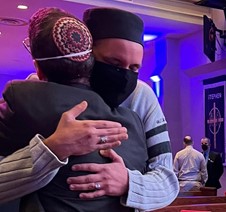
Photo caption: Imam Omar Suleiman hugs Rabbi Charlie Cytron-Walker after the rabbi’s escape from being held hostage at Congregation Beth Israel synagogue on Jan. 15.
Asra Kahn photo
In The Wake Of Texas Hostage Situation, Tightened Security At Our Shul
In the wake of the frightening events in Texas, shul members planning to attend Shabbat services in person are asked to arrive by 7:30 p.m. on Fridays and by 9:30 a.m. on Saturdays. The doors will be locked when services begin. Latecomers must knock and identify themselves before the door will be opened.
Shul president Judith K. Weiner, Rabbi Gadi Capela and several board members attended a Zoom meeting on Jan. 18 to hear U.S. government officials discuss security measures to foil antisemitic activity. Speakers included Attorney General Merrick Garland, Department of Homeland Security Secretary Alejandro Mayorkas, FBI Director Christopher Wray, White House Director of Faith Partnerships Melissa Rogers, and others. The shul will follow up on recommendations, and with local law enforcement.
Get Social