Jewish Communities Worldwide Dedicate Purim Holiday To Ukrainians
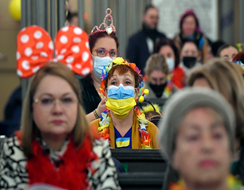
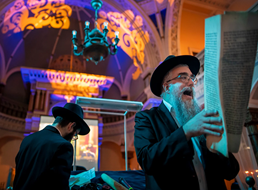
A woman wears masks in the colors of the Ukrainian flag as Romania’s Jewish community celebrates Purim in the Coral Temple synagogue in Bucharest, Romania. Photo, right, Rabbi Sholom Krinsky reads the Torah at a shul in Vilnius, Lithuania. Purim, which commemorates the salvation of the Jews in ancient Persia, as recounted in the Bible’s Book of Esther, prompted prayers for peace in the Ukraine, now beset by Russian troops.
JNS photos
Scholarship Opportunities In The Arts
North Fork Reform Synagogue has announced the awarding of the second annual Linda Rie Cohen Scholarships, a $10,000 endowment from Fred Cohen to honor the memory of his late wife, who died in June 2013. The scholarships are awarded to candidates seeking pursue education in the arts and sciences, in keeping with Linda Rie Cohen’s lifelong passion for music, the arts, and education.
Applications are posted on the synagogue’s website, northforkreformsynagogue.org, and must be received by May 15, 2022.
A Centennial Celebration: The First Bat Mitzvah Held On March 18, 1922
On March 19, 1922, Mordechai Kaplan, one of the founders of Reconstructionist Judaism, led his daughter Judith through the blessings and verses of the first bat (bas) mitzvah. As Judith Kaplan famously recounted, “The moment itself was fairly uneventful: no thunder sounded, no lightning struck.”
In her book about Judith Kaplan’s story, Rabbi Sandy Eisenberg Sasso says to all young women: “You are linked with people from long, long ago. Stay connected. Find joy in being Jewish.”
Just Released, Brad Kolodny Book About Jewish Settlers Of Long Island
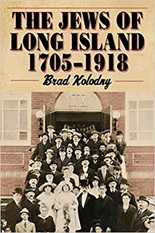 Brad Kolodny, who talked about the early synagogues of Long Island at the shul’s Lunch and Learn program in December 2021, has just published a new book, The Jews of Long Island 1705-1918. In this book, the writer tells the stories of Jewish communities on Long Island, and how they were established and developed. His research confirms what we know about the early Jewish settlement in Greenport and the building of our shul more than 100 years ago. Peddlers, farmers and factory workers struggling to make better lives for their families moved east, out of the poverty and congestion of New York City.
Included in Brad Kolodny’s book are census records, newspaper accounts, photos, and personal family histories. More than 4,400 names of people who lived in Nassau and Suffolk counties prior to the end of WWI are listed. The writer told The Shofar that the book contains a chapter dedicated to Greenport, including the names of every Jewish resident at that time.
Russian Missile Strike Hits Holocaust Memorial Site In Kyiv, Ukraine
Russian missiles hit the Babyn Yar Holocaust memorial site in Kyiv in an air strike apparently targeting a television broadcasting tower near the center of the Ukrainian capital. Ukrainian authorities said five people were killed during the attack on March 1. The site is Europe’s largest mass grave for victims of the Holocaust.
According to the Babyn Yar Center’s website, Nazi forces killed between 70,000 and 100,000 people between 1941 and 1943, including almost the entire population of Kyiv. The non-governmental memorial center is developing a new Holocaust museum complex, scheduled to open in 2025-26.
Scholarship Opportunities In The Arts
North Fork Reform Synagogue has announced the awarding of the second annual Linda Rie Cohen Scholarships, a $10,000 endowment from Fred Cohen to honor the memory of his late wife, who died in June 2013. The scholarships are awarded to candidates seeking pursue education in the arts and sciences, in keeping with Linda Rie Cohen’s lifelong passion for music, the arts, and education.
Applications are posted on the synagogue’s website: northforkreformsynagogue.org, and must be received by May 15, 2022.
Latvian Jewish Community To Receive $46 Million For Holocaust Losses
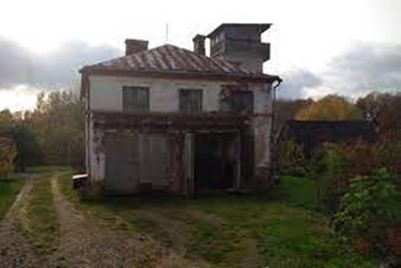 The 19th-century synagogue in the southern Latvian town of Akniste has become a firefighting depot. An older synagogue, with wooden vaulted ceilings, is now a community center, and another synagogue has been turned into a church.
After the Latvian Jews who owned, managed and frequented the buildings were killed during the Holocaust, the state took them over. But now, 80 years later, the Latvian Jewish community will be reimbursed for hundreds of buildings that were appropriated during the war and never returned.
The Latvian Parliament has given final approval to an award of 40 million euros (about $46 million) to the Latvian Jewish community to “eliminate the historical unjust consequences” resulting from Holocaust activities, according to a news release that was reported in The New York Times.
In 1940, the Soviets invaded Latvia and nationalized Latvians’ properties. Shortly after, Nazi Germany occupied the country and killed 90% of its 93,000 Jews — 25,000 of them in a two-day mass shooting in the Rumbula forest.
“This award cannot bring back a destroyed community or a destroyed synagogue,” said Gideon Taylor, a chairman of the World Jewish Restitution Organization, one of the main promoters of the bill. “But what it can do is recognize what happened, and this is why it is important.”
[Pictured, synagogue is now a firefighting depot. Museum Jews in Latvia/The New York Times]
Get Social